


Abstract
Antonio Sałieri emerges as a central institutional figure in late eighteenth- and early nineteenth-century Viennese musical life, combining artistic production with administrative authority and pedagogical influence. Born in 1750 in Lenjago within the Venetian Republic and trained in Venice, he rose rapidly after relocating to Vienna, becoming court composer in 1774 and Hofkapellmeister in 1788. His output, exceeding forty operas, reflects a pragmatic mastery of musical theater, shaped by real performers, audiences, and institutional demands. Major works such as L’Europa riconosciuta, Tarare, and Axur, re d’Ormus illustrate his international stature and responsiveness to evolving tastes across Italian, French, and German operatic traditions.
The enduring image of Sałieri as Mozart’s envious antagonist originates in literary and cinematic constructions rather than historical documentation. Contemporary evidence points instead to professional coexistence within a competitive court environment, including documented collaboration and mutual respect. Salieri’s role as an educator further underscores his significance: he instructed or mentored figures such as Beethoven, Schubert, Liszt, and Franz Xaver Mozart, shaping musical generations beyond his own compositions. Modern reassessment positions Salieri not as a footnote to genius, but as a key architect of Vienna’s musical ecosystem and a representative figure of its institutional culture.
Introduction
While today the name Antonio Sałieri often evokes the shadow of Mozart’s alleged murder, in Vienna between the 18th and 19th centuries he was a star in his own right and a center of gravity. He was a sought-after composer, a man of the establishment, an architect of other people’s careers and, above all, a professional of musical theater in the full sense of the term: capable of writing for real singers, real orchestras, real stages, and for an audience that wanted emotion, dramatic clarity, and vocal splendor.
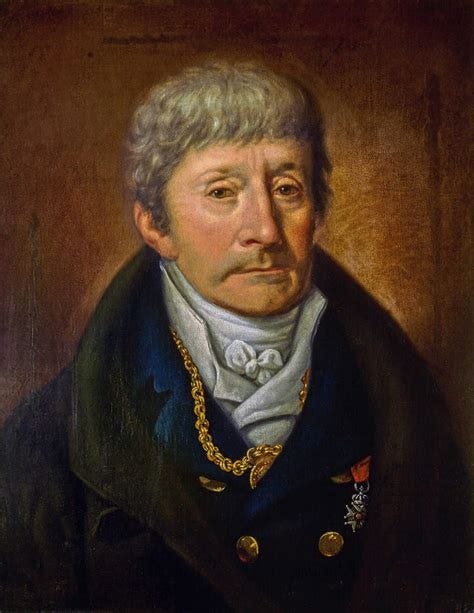
Born Venetian and educated in Venice, Sałieri was adopted by the Habsburg capital out of vocation and necessity: he entered the cultural machinery of the Empire and remained there for the rest of his life, becoming one of its longest-serving and most influential artistic officials. His story also recounts a transition between eras: the season of Italian opera’s hegemony in European courts, the competition between national styles, the evolution of tastes, and finally the construction of a popular myth that transformed him into a narrative antagonist.
From Lenjago to Vienna, via Venice
Antonio Sałieri was born in Lenjago, near Verona, on August 18th, 1750, in what was then part of the Venetian Republic. He was exposed to music early on in his family: he initially studied locally and then, after a childhood marked by hardship and loss, he moved to Padua and then Venice, where he received a more structured education (basso continuo, singing, theater practice). It was here that he had a decisive encounter: Florian Leopold Gassmann, a court musician in Vienna, noticed him and took him with him to the imperial court.
In Vienna, Sałieri entered a network of patronage and relationships typical of the capital and the Habsburg court. According to biographical reconstructions, he was also encouraged and supported by influential figures such as Gluck and Metastasio, who in those years represented the high horizon of reformed opera and poetry for music. His first success came quickly: as early as 1770, an opera such as Le donne letterate (“The Learned Women”) was performed at the Burgtheater, and from then on his theatrical presence became permanent.
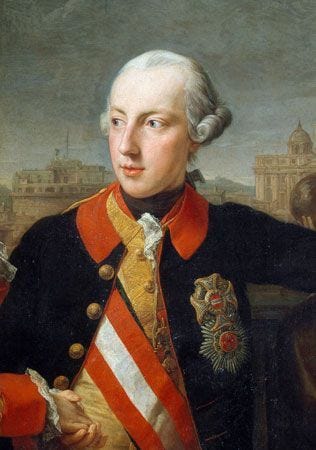
The institutional leap was rapid. In 1774, Emperor Joseph II appointed him court composer and also entrusted him with responsibilities related to Italian opera in Vienna; in 1788, Sałieri reached the top by becoming Hofkapellmeister (court chapel master). From here, Salieri went from being a composer to a true artistic director, called upon to guarantee standards, repertoire, the functioning of chapels and theaters, and relations with singers and impresarios.
In his later years, his creative activity slowed down: after 1804, he no longer presented new theatrical works and concentrated mainly on sacred music and teaching. A serious mental illness forced him to gradually withdraw from public life; he would die in Vienna on May 7th, 1825.
Main works
Sałieri was, above all, a musical theater composer. His catalog includes over 40 operas, some milestones are particularly emblematic:
L’Europa riconosciuta (1778). This is a historic calling card: the opera with which La Scala opened on August 3, 1778. It was no ‘normal’ commission: it was a prestigious cultural undertaking in a Milan that wanted a new temple of opera. The fact that the opening took place with Salieri says a lot about his reputation at the age of just 28.
La scuola de’ gelosi (late 1770s). A key title for understanding his effectiveness in comic opera: plots, characters, ensembles; the ability to make the stage machinery ‘turn’ without losing musical intelligibility. In Salieri, humor is never just gags: it is a dramaturgical mechanism.
Les Danaïdes (Paris, 1784). Here Salieri demonstrates his ability to play on the international stage of French tragédie lyrique and ‘serious’ opera. It is one of the works that historiography points to as a high point of his theatrical effectiveness.
First the music, then the words (1786). A lightning-fast, meta-theatrical divertimento that pokes fun at the opera industry: capricious singers, impossible deadlines, compromises between poet and composer. It is also a crucial piece in his relationship with Mozart because it was written in the context of a court “competition.”
Tarare (1787) and Axur, King of Ormus (1788). Tarare, with a libretto by Beaumarchais, is one of his greatest successes; Lorenso Da Ponte created the Italian version, Axur, which for a time was more popular with the Viennese public than Mozart’s Don Giovanni: a fact that should be interpreted not as an ‘eternal ranking’ but as a snapshot of Viennese tastes and fashions in the late 1780s.
Falstaff (1799). Also interesting from a historical and cultural point of view: a mature Sałieri working on a Shakespearean subject (The Merry Wives of Windsor), a sign of how European theater was changing its references and imagery.
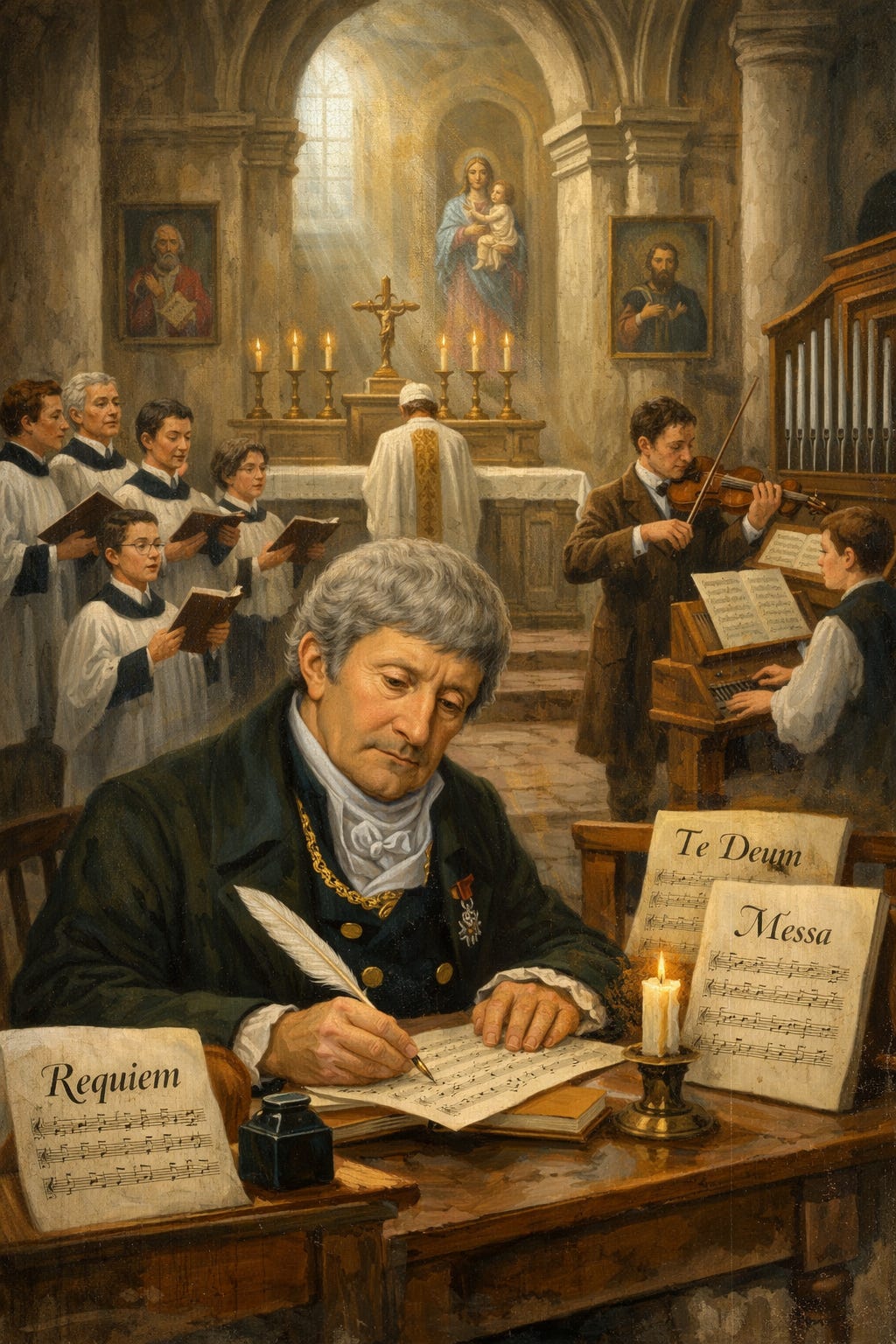
Alongside opera, Sałieri wrote a great deal of vocal and sacred music. His liturgical corpus is not as extensive as his operatic output, but it includes masses, a Requiem, Te Deum, and other compositions, often described as sober and attentive to the comprehensibility of the text, less inclined toward “theatrical” effects in church than other contemporaries.
The Dark Legend of Sałieri: the Man who killed Mozart
Amadeus and its consequences
Buried by the sands of time, the figure of Antonio Sałieri returned forcefully to the limelight thanks to the famous film Amadeus (1984), winner of eight Academy Awards.
Despite the title, the protagonist of the film is not Wolfgang Amadeus Mozart, but Antonio Sałieri himself. The film shows the rise of Mozart from the point of view of the Venetian composer, who narrates it in first person as an elderly man. Mozart is portrayed as a brilliant artist but with a rather bizarre character and manner, irreverent to the etiquette of the Habsburg court and to the austere Salieri.
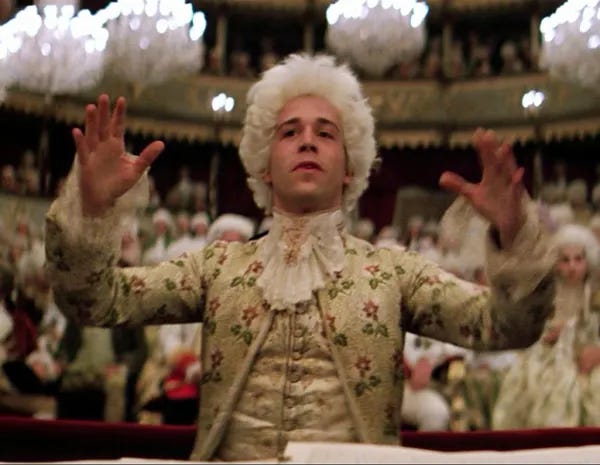
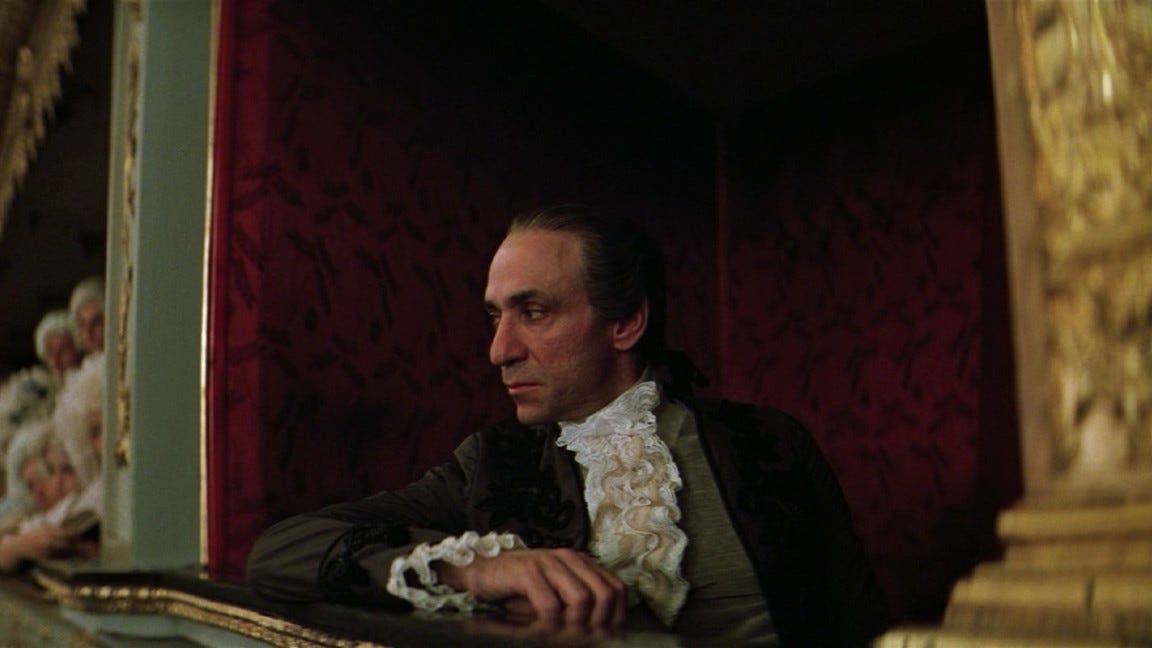
Despite all his efforts to thwart Mozart’s success, the brilliant composer can only watch helplessly as his rival’s career flourishes, believing it has been built at his expense. This is a film that tells the story of envy and how it can consume a person. Using extraordinary characters, such as artists and rulers, it describes a state of mind that ordinary people may experience towards a colleague whose success they feel is undeserved.
In the end, envy turns to hatred, and hatred to obsession, until the tragic fulfillment of a Machiavellian plan devised by Sałieri to get rid of the infamous Mozart.
However, the real purpose of the film is not to be historically accurate, but to narrate a very powerful human story in an evocative and realistic atmosphere. From our point of view, it succeeds very well. Amadeus is a masterpiece.
However, Antonio Sałieri emerges from this film as a strongly negative figure, a saboteur of music history rather than a great contributor to it. Let’s try to clarify.
“If Sałieri didn’t kill Mozart, Pushkin killed Sałieri.”
The famous rumor that Antonio Sałieri poisoned Mozart stems more from literature than from history. It was Aleksandr Pushkin, with his tragedy Mozart and Sałieri, who fixed in the collective imagination the idea of the envious and murderous “Italian”, a legend later amplified by Miloš Forman’s film.
In reality, the balance of power was the opposite of that described in the myth. Sałieri enjoyed positions, salaries, and prestige superior to those of Mozart, and was a highly respected teacher, so much so that he was Beethoven’s teacher. The accusations of conspiracy, plagiarism, and even attempted murder came rather from Mozart’s circle, fueled in part by Leopold Mozart. However, even during his lifetime, Salieri became the target of increasingly insistent slander, which ended up undermining his mental health. Contemporary accounts, also reported in Beethoven’s conversation books, show that rumors were openly circulating in Vienna that Salieri was responsible for Mozart’s death.
The “black legend” was further consolidated by Russian culture, with Rimsky-Korsakov’s opera Mozart and Sałieri, which Rachmaninoff also attended at its premiere. Meanwhile, the real causes of Mozart’s death remained uncertain: fever, illness, poverty, or other hypotheses, but with no evidence against Sałieri.
Today, the Venetian composer has been largely rehabilitated historically and musically. Yet the global success of Amadeus, which won eight Oscars, has made the link between the two names indissoluble, leaving Salieri still in the cumbersome shadow of Mozart’s genius.
What really happened
The Sałieri-Mozart conflict must be viewed within the context of Vienna at that time: a musical capital is, by definition, a competitive system made up of prestigious positions, commissions, singers, impresarios, and aesthetic “parties.” In this context, friction and suspicion were inevitable. But reducing the relationship between the two to a continuous (and even criminal) personal war is perfect for biographical melodrama, but terrible for historical accuracy.
A first fact, often ignored because it does not fit with the legend, is that the young Mozart did not ‘avoid’ Salieri: in 1773, he composed and dedicated six piano variations (K. 180) on the theme ‘Mio caro Adone’ (My dear Adonis), taken from Sałieri’s opera ‘La fiera di Venezia’ (The Fair of Venice), performed in Vienna in 1772. In a prudent key, it is a gesture of homage and positioning: recognizing the rising star of the Viennese theater scene and introducing himself into that orbit with an elegant tribute.
The second factor is political and institutional: the court of Joseph II alternates (with mixed results) between a “national” project in German and the reopening of the “Italian” opera machine; in this context, Sałieri is one of the key figures in theater management, and Mozart, when he arrives in Vienna permanently, will move within the same ecosystem. The ‘ethnic’ or ‘factional’ opposition - “Italian” versus German - exists as rhetoric and rumor, but a reading based on facts also highlights cooperation, overlapping networks, and court choices that often place them side by side.
The most concrete evidence of this coexistence is not an anecdote, but a page of music: in 1785, Sałieri and Mozart (with a third author listed as Cornetti) participated in the cantata ‘Per la ricuperata salute di Ofelia’ (For the Recovery of Ophelia’s Health), with lyrics by Lorenso Da Ponte, composed to celebrate the recovery of soprano Nancy Storace. The piece, long believed to be lost, was identified in 2015 and helped to refocus attention on an essential point: professional rivalry (when it exists) does not preclude good manners, collaboration, and even a certain camaraderie within the profession.
Even the ‘symbolic’ episode of the 1786 confrontation - the court evening with the two short acts, Mozart’s Der Schauspieldirektor and Sałieri’s Prima la musica e poi le parole – should be read in this way: a competition, yes, but above all a staging of the imperial theater factory, with satirical and meta-theatrical elements, and not the final act of a personal duel.
Finally, many of the ‘conspiracies’ attributed to Sałieri in the posthumous imagination (for example, around the dynamics of the Burgtheater and the reception of Mozart’s works) can be more plausibly explained by prosaic factors: calendars, contractual priorities of the theater, rivalries between librettists, and court protections. In a documentary source (stage notes), the idea of Salieri organizing traps is put into perspective by recalling that, a few months earlier, Mozart and Sałieri had collaborated on the cantata for Storace, and that Sałieri also kept Mozart’s sacred music in the court repertoire.
As for the myth of poisoning, it remains what it is: a literary and then cinematic construct, fueled by late rumors and lacking any solid evidence. It is a powerful story, but it does not describe the real Vienna.
Sałieri, the “Career Architect”
Now that the reputation of the Veronese composer has been restored, let us return to discussing his relationship with other artists. In particular, let us consider all those who benefited from Salieri’s collaboration and recommendations during their careers.
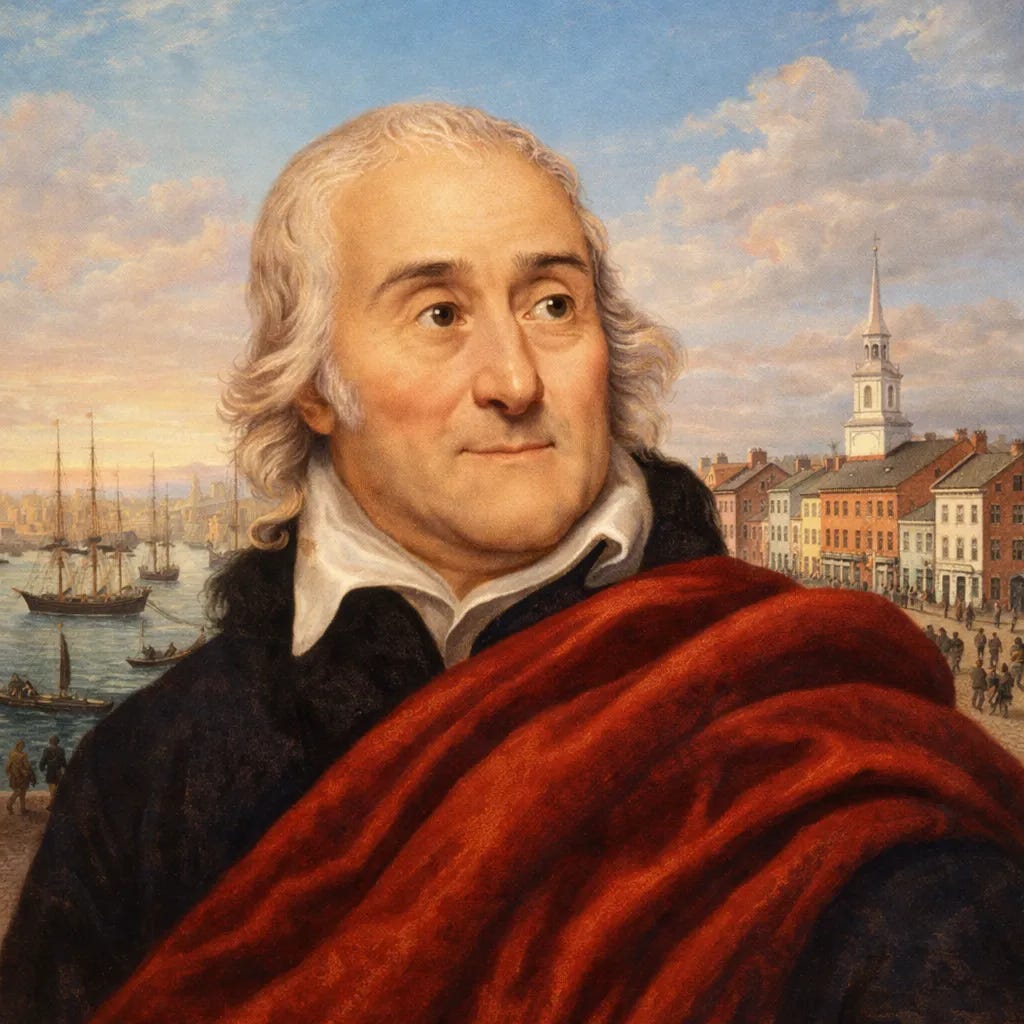
Lorenso Da Ponte is one of the most romantic figures in European musical theater: born Emanuełe Conejan, a Jew who converted to Catholicism and was ordained a priest, he had an irregular youth spent between seminaries, Venice, and exile, until he reinvented himself as a librettist in the capitals of the Empire. His relationship with Salieri was both personal and professional: it was Sałieri, already well established at court, who supported him and ‘pushed’ him into Viennese society, facilitating his access to the role of poet for the imperial theaters.
From that moment on, the two worked as a functional couple typical of Joseph II’s Vienna: Sałieri as an institutional musician and man of the theater, Da Ponte as a supplier of “tailor-made” librettos. Their most famous collaboration is Axur, re d’Ormus (1788), the Italian version of Tarare (music by Sałieri), but Da Ponte also wrote other texts for Sałieri. At the same time, of course, Da Ponte also became Mozart’s great librettist: and it is precisely this intersection - the same poet writing for both -that puts the idea of two enemy camps into perspective, restoring instead the real image of a theatrical world made up of networks, patronage, opportunism, and professional alliances.
Franz Schubert - This is probably the most typical example of a “teacher-student” relationship: Sałieri taught him for years (at the city choir school and in private lessons), particularly in counterpoint and Italian vocal composition. In 1821, Schubert respectfully dedicated the first edition of his Lieder on Goethe to Salieri: a gesture that would not have been made to a marginal teacher.
Franz Liszt - As a child prodigy, he studied piano with Czerny and composition with Sałieri in Vienna: here, the help was not only technical, but also cultural - being a pupil of the court Kapellmeister opened doors and gave credibility.
Carl Czerny - Before becoming the great ‘hub’ of 19th-century piano teaching (and Liszt’s teacher), he was also trained by Sałieri. It is an interesting case because the ‘architecture’ here is indirect: Sałieri → Czerny → generations of pianists and composers.
Ignaz Moscheles - Virtuoso and composer, then a key figure in Vienna and London: Britannica explicitly mentions studies in Vienna with Albrechtsberger and Sałieri. Here too, Sałieri acts as a Viennese “certification” and as a bridge to the publishing and concert circuit.
Johann Nepomuk Hummel - He belongs to the Viennese classical galaxy who “made a career” thanks to an elite education: various institutional biographies indicate him as one of those who, upon returning to Vienna, also studied with Salieri (along with Albrechtsberger and Haydn).
Franz Xaver Wolfgang Mozart (Mozart’s son) - Here the symbolic value is enormous (and anti-mythological): he also received excellent musical instruction from Sałieri, who thus contributed directly to the training of the son of his supposed “enemy.”
Ludwig van Beethoven - Not “born” thanks to Sałieri, of course, but strengthened in a specific area: Beethoven sought out Sałieri to refine his style of vocal/Italian composition (useful for opera and writing on text). It is a form of targeted mentorship between two professionals.
Rediscovery and Redemption

The current rediscovery of Antonio Sałieri, which is due to cyclical changes in artistic trends, comes at a pivotal moment in the identity landscape of the Italian peninsula, which is currently experiencing significant underlying international geopolitical upheavals.
Now is the time to reintroduce great historical figures of the past, acknowledging their true ethnic affiliations rather than generically labelling them all as ‘Italians’, nowadays a term with political rather than geographical connotations. Claiming that figures such as Sałieri and Marco Poło were Italian rather than Venetian is akin to saying that Julius Caesar was Italian rather than Roman. We delved into this topic in the following article:
Amadeus is a film that is often shown in public schools in Italy, and that is how we at Third Venetia first discovered Sałieri many years ago. We are pleased that, after contributing to the dark legend, the film is now increasing his fame among interested audiences.
Sources
Enciclopedia Britannica, voce “Antonio Salieri”. (Encyclopedia Britannica)
Treccani, Dizionario Biografico degli Italiani, voce “Salieri, Antonio” (Francesco Blanchetti). (Treccani)
Treccani, voce enciclopedica “Salièri, Antonio”. (Treccani)
Treccani, Enciclopedia Italiana (1936), voce “Salieri, Antonio” (Andrea Della Corte). (Treccani)
Teatro alla Scala, “History timeline” (apertura 1778 con L’Europa riconosciuta). (Teatro alla Scala)
Wiener Hofmusikkapelle, profilo “Antonio Salieri” (incarichi di corte, inquadramento della musica sacra). (Hofmusikkapelle)
Habsburger.net, “Mozart vs. Salieri 0:1 – a musical contest at the imperial Court” (contesto della competizione di Schönbrunn). (Die Welt der Habsburger)
Wikipedia (consultazione rapida per dati di contesto e ricezione moderna; da incrociare con le fonti sopra). (Wikipedia)
Treccani, Enciclopedia Italiana, voce “DA PONTE, Lorenzo” (Giulio Natali). Treccani
Enciclopedia Britannica, voce “Antonio Salieri” (passo su collaborazione con Da Ponte dal 1783). Encyclopedia Britannica
Enciclopedia Britannica, voce “Lorenzo Da Ponte”. Encyclopedia Britannica
Royal Ballet & Opera (Covent Garden), profilo “Lorenzo Da Ponte” (collaborazioni con Salieri nel periodo viennese). Royal Ballet and Opera
Wikisource, Memorie (Da Ponte) – Elenco dei componimenti teatrali (riferimenti ai libretti musicati da Salieri). Wikisource
Library of Congress, edizione storica di Axur, re d’Ormus (attribuzione Da Ponte/Salieri). loc.gov
Giuseppe Rausa, “Mozart e Salieri: l’alleanza segreta” (contenuti ripresi/ristampati nell’articolo di Rausa su Musicaaa! Musicaaa!, n. 38, consultabile via Yumpu). YUMPU+4YUMPU+4YUMPU+4
RSI, “Alla ricerca dell’inesistente inimicizia” (variazioni K. 180 e quadro interpretativo del rapporto). rsi
IMSLP, “Per la ricuperata salute di Ofelia (Various)” (attribuzione e dati essenziali dell’opera). imslp.org
Fundación Juan March, note di sala (PDF “Mozart y Salieri”: contesto su cantata, voci di “congiura” e repertorio liturgico). recursos.march.es
Quando Pushkin uccise Salieri meer.com