



In 1788, the Venetian publisher Domenico Fracasso issued two volumes bearing an unusual title: Omero in Lombardia. Iliade. Their author, the Paduan abbot Francesco Boareti (italianized Boaretti), had translated all 24 books of the Iliad into a composite Venetian language, shaped into ottava rima and intended to be understood beyond the boundaries of any single city of Venetia.
The work is sometimes remembered as a dialectal curiosity: a Homer transformed into a figure from popular comedy, with Achilles, Agamemnon, and the gods of Olympus speaking like inhabitants of the Venetian mainland. This interpretation certainly captures part of the effect produced by the text, but it risks overlooking the true scale of Boareti’s ambition.
Rather thsn merely attempting to make Homer comic, one could argue that Boareti sought to demonstrate that Venetian could sustain a long, complex poem universally recognised as one of the summits of world literature. In this sense, Omero in Lombardia was an experiment in literary language: not yet a standard, but a conscious attempt to construct a supra-local poetic medium capable of connecting Venice with the cities of the mainland and of addressing subjects far beyond ordinary conversation.
The Life of Francesco Boareti
Francesco Boareti was born on 16 August 1748 in Masi, a village situated along the Adige river opposite Badìa. His education began at the seminary in Badìa and continued, from the age of fifteen, at the seminary of Padua. There he studied literature, philosophy, and the sciences, distinguishing himself through the breadth of his interests. In 1769 he graduated in philosophy and, after being ordained as a priest, was appointed to teach the same subject at the Paduan seminary.

Boareti belonged to that 18th century ecclesiastical culture in which the study of ancient languages coexisted with philosophy, theology, mathematics, and the natural sciences. Although he worked within an intellectual environment relatively open to new ideas, his religious and political positions remained decidedly conservative. He preferred philological erudition to the most innovative philosophical controversies of his age and opposed both Jansenism and political theories founded upon popular sovereignty and the natural rights of man.
His principal interest gradually became the translation of ancient texts. In 1784 he published a version of the Homeric Hymn to Demeter and, in the same year, the first twelve books of the Iliad in Venetian. In 1785 he left Padua after being summoned by the government of the Republic to teach sacred eloquence in the public schools for clerics established in Venice. This appointment placed him directly within the educational institutions of the Venetian State, although poor health later forced him to withdraw from teaching.
During the following years, Boareti continued an intense activity as a translator. He worked on the Psalms, Ecclesiastes, and the Book of Wisdom, as well as on tragedies by Euripides and Sophocles. His linguistic choices varied according to the nature of the text: for sacred works he preferred a restrained and relatively literal style, whereas for drama and Homer he accepted greater metrical and expressive freedom.
In 1795 he suffered an apoplectic attack that seriously impaired his ability to work. After the fall of the Republic in 1797, he composed several stanzas dedicated to liberty, equality, and democracy, thanking the new Venetian government for confirming his pension. It would probably be excessive to interpret these verses as evidence of a genuine ideological conversion. They appear instead to reflect the need to adapt to a new political order at a time when his personal circumstances had become increasingly precarious. He died in Venice, in the parish of San Vidal, on 15 May 1799.
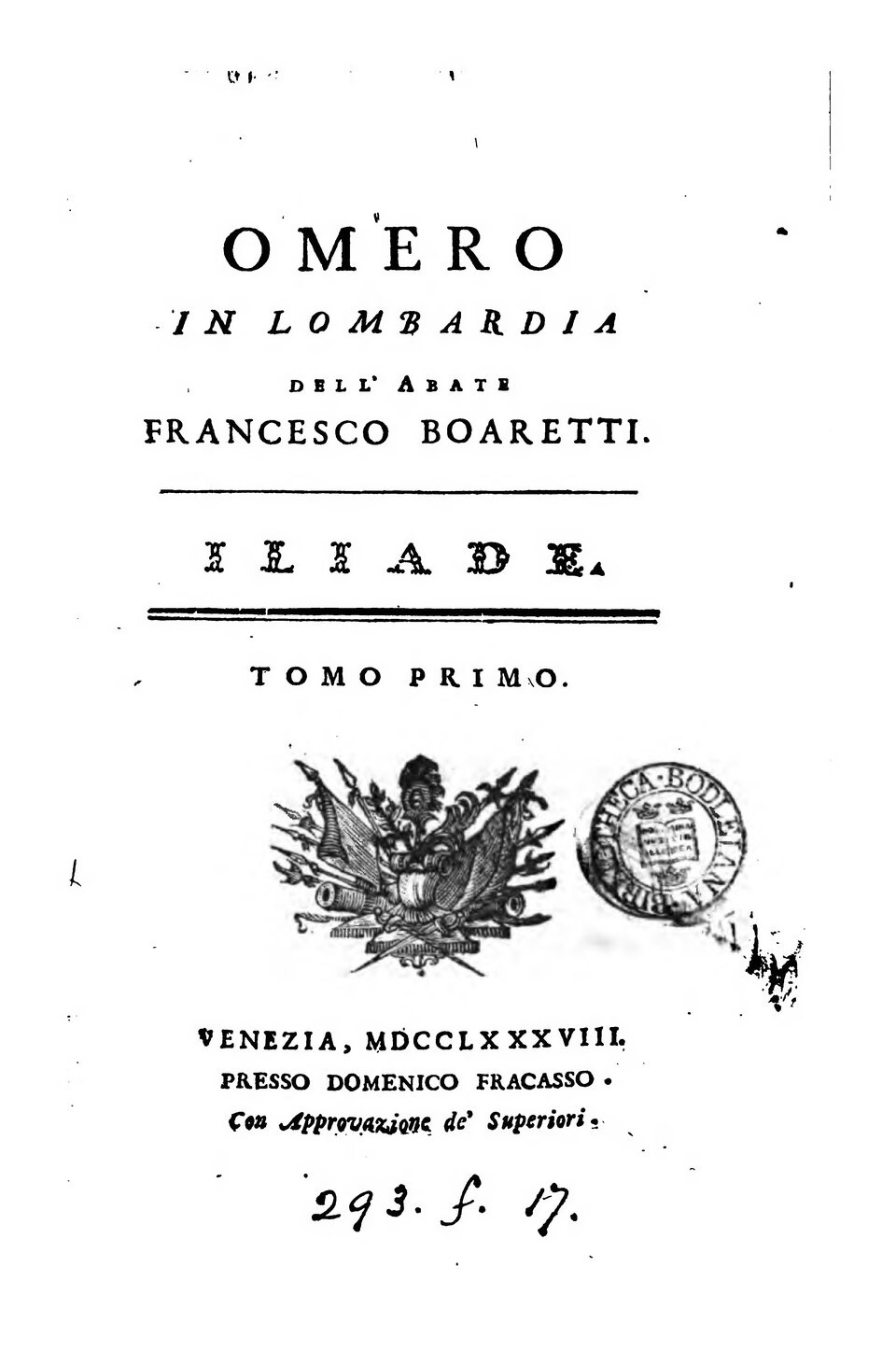
The publishing history of Omero in Lombardia unfolded in two stages. In 1784 the first twelve books of the Iliad appeared in Padua. Four years later, Boareti published the complete and revised version in Venice, divided into two volumes: the first contained Books One to Twelve, while the second contained Books Thirteen to Twenty-Four. The work was dedicated to the young patrician Antonio Zeno, son of Sebastiano Zeno, whose education Boareti had helped supervise.
The dedication immediately reveals the pedagogical function assigned to the translation. Boareti presented his work as an instrument through which an educated young reader might approach Homer before acquiring sufficient knowledge of Greek. The poem was to preserve the seriousness of its themes while presenting them “under a pleasant and facetious appearance”.
Humour was therefore not the ultimate purpose of the work. It was a means of making accessible a text perceived as remote, lengthy, and difficult. Boareti intended to bring the reader closer to the narrative structure, characters, and passions of the Iliad, reducing at least part of the linguistic and cultural distance separating an eighteenth-century audience from the Homeric world.
Why Omero in Lombardia?
The title may be misleading to a modern reader. Boareti’s “Lombardy” did not simply correspond to the present-day Italian administrative region. The term could still be used in a broader geographical sense, referring more generally to northern Italy and its languages.
Boareti himself provocatively described his language as a Lombardazzo, implicitly contrasting it with the prestige of literary Tuscan. The term has an ironic and almost defensive quality: Boareti anticipated the objection of educated readers who might accuse him of degrading Homer by making him speak in vernacular language.
Yet when he explains his method more concretely, the geographical and linguistic centre of the experiment becomes clearer. Boareti states that the first part of the work had been understood and appreciated in the “Venetian Dominant”, meaning Venice, in the neighbouring cities, and even in other parts of Italy. The language of Omero in Lombardia therefore belongs primarily to the Venetian world, while also incorporating broader northern Italian forms and refusing to identify rigidly with a single municipal variety.
It is not strictly Paduan, although Boareti’s background remains recognisable. Nor is it urban Venicean, despite the cultural and political prestige of the capital. It is what we might today describe as an experimental literary koiné: a language constructed through the selection of words, forms, and sounds drawn from several varieties of Venetian.
Boareti states this explicitly: “I did not confine myself to one single and determined dialect.”
A Supra-Local Venetian Language
The decision to combine several varieties was not motivated solely by the desire to reach a wider audience. It also responded to precise poetic requirements. A translation in verse demanded a broad range of words, endings, and rhymes. Restricting himself to a single local speech would have reduced the translator’s metrical and lexical options.
Boareti therefore selected the forms that appeared to him most forceful, comprehensible, and effective. The result does not correspond to a standardised language according to modern criteria. There is no explicit grammar, no universal orthography, and no compulsory linguistic norm. There is, however, a clear awareness that Venetian varieties could be combined within a common literary system.
Even more significant is the social observation contained in the preface. Boareti states that he employed words used in familiar conversation by noble and educated people when discussing literature, politics, and other important subjects. The vernacular therefore does not appear as a language confined to peasants, the lower classes, or theatrical comedy. It was also an ordinary medium of communication among members of the Venetian and mainland elites.
This testimony helps clarify the linguistic situation of the Republic during the final decades of the eighteenth century. Literary Italian (standardized Tuscan) dominated the most formal forms of print, while Latin retained important ecclesiastical and academic functions. Venetian, however, remained the living language of conversation and could also be used to discuss complex subjects.
Boareti attempted to transfer this oral competence into written poetry.
Homer in Ottava Rima
Another fundamental decision was the adoption of ottava rima: stanzas of eight hendecasyllabic lines following an ABABABCC rhyme scheme. This was the metre of the Italian epic tradition of Ariosto and Tasso and was deeply familiar to readers of the period.
The choice inevitably transformed the rhythm of the original. The Greek Iliad is composed in dactylic hexameters and emerged from a poetic tradition based upon formulae, repetition, and narrative structures shaped by oral performance. Ottava rima, by contrast, belonged to the Italian chivalric tradition and tended to organise the story into closed units, often concluding with an effective, ironic, or sententious observation.
Boareti did not therefore attempt to reproduce Homer’s metre. He transferred the poem into the literary system known by his readers. In doing so, the Trojan War was brought closer to the world of the Orlando Furioso and the Gerusalemme Liberata.
The operation was far from modest. Boareti maintained that his language could adapt itself to all the poetic forms found in Ariosto and Tasso, including both pathetic and energetic passages. Venetian could, in his view, possess the same metrical flexibility attributed to literary Italian.
A Faithful Translation?
According to contemporary standards, Omero in Lombardia cannot be considered a strictly literal translation. Boareti intervened substantially in the structure of the original.
In his preface, he explains that he omitted numerous repetitions, recurring epithets, certain genealogies, and several mythological narratives that he considered secondary to the main action. In some cases he altered the order of the verses to clarify the sequence of events. He also added lines and entire stanzas intended to connect or explain difficult passages, while claiming that these additions amounted to fewer than two hundred lines in total.
His aim was to preserve what he considered essential: the action, the characters of the heroes, their customs, their passions, and the principal poetic images. In the passages he regarded as most noble and original, he claimed to have translated with greater rigour, at times following the Greek text very closely.
The result is therefore a selective translation, or more precisely a poetic adaptation. Boareti did not intend to produce a philological instrument for specialists, but an autonomous work designed for continuous reading. Fidelity was subordinated to intelligibility and narrative effectiveness.
This conception was not exceptional in the eighteenth century. Many translators considered it legitimate to correct, abbreviate, or reorganise ancient authors in order to adapt them to modern taste. Boareti’s originality lay in applying this method not to Tuscan, but to a Venetian language specifically constructed for the undertaking.
Achilles Enters the Venetian World
The beginning of the first book immediately reveals the character of the translation. The invocation to the Muse is replaced by a more direct entrance into the subject:
Canto d’Achille […] Quela Rabbia famosa
I sing of Achilles […] that famous Rage
The celebrated anger of Achilles becomes a violent and concrete “rage”. Fallen heroes are sent “a cenar con Pluton” (“to dine with Pluto”), while abandoned bodies are devoured by dogs.
The effect may appear comic, especially to readers who associate Venetian with familiar conversation. Yet the scene preserves the brutality of the original. The language does not erase the war; it makes it more immediate.
The same occurs in the dialogues. Agamemnon does not speak like a neoclassical statue, but like an irascible commander capable of brutally threatening the priest Chryses. Achilles argues, insults, and reacts according to a logic comprehensible to a contemporary reader. Military hierarchies, conflicts of honour, and personal interests acquire an almost political concreteness.
Boareti frequently adds observations of a general nature. In the summary of the first book, the dispute between Agamemnon and Achilles leads to the reflection that the follies of leaders and kings can destroy entire provinces and nations.
This was not an alien statement within the political culture of the Republic of Venice. An eighteenth-century reader could recognise in it a reflection upon governmental responsibility, political prudence, and the collective consequences of individual passions. Troy is not simply transferred to Venetia; it is interpreted through the moral and political categories of the Venetian world.
Parody or Popularisation?
The presence of colloquial expressions, sententious conclusions, and familiar images has led some readers to classify the work as a parody. The risk of a comic interpretation was certainly present, and Boareti was fully aware of it. His introduction anticipates, with sarcasm, the accusations of the learned critics scandalised by the idea of contaminating an excellent poet with vernacular language.
Yet reducing Omero in Lombardia to a joke does not do justice to the project. The translation includes all twenty-four books, is preceded by a lengthy discussion of Homeric religion, morality, customs, and characters, and was produced by a Greek scholar who worked directly from the original text.
Boareti took Homer seriously. What he did not necessarily take seriously was the idea that the dignity of a work depended upon the elevated character of the language into which it was translated.
The facetious tone served a precise function: to maintain the reader’s attention throughout a very long poem. Humour was intended to accompany the great action without destroying its seriousness. It was a strategy of popularisation before it was a form of parody. Even Melchiorre Cesarotti, one of the most important eighteenth-century translators and interpreters of Homer, reportedly expressed a favourable judgement of the work.
A Missed Opportunity for the Venetian Language
It would be anachronistic to present Boareti as a modern linguistic codifier or as an activist for the Venetian cause. He did not elaborate a political programme founded upon language, nor did he attempt systematically to replace Italian in the public uses of the Republic.
His work nevertheless demonstrates that, at the end of the eighteenth century, an educated intellectual could conceive of Venetian as something more than a collection of municipal dialects. Boareti began with the plurality of local varieties, but did not regard it as an insurmountable obstacle. On the contrary, he used their diversity as a resource for constructing a richer poetic language.
This is probably the most important legacy of Omero in Lombardia. The work does not prove that a standard Venetian language already existed. It does, however, show that a supra-local literary language could be imagined and, at least in part, realised.
The project remained isolated. The fall of the Republic in 1797 removed the institutional framework within which such experimentation might have developed. During the nineteenth century, the gradual integration of the different Venetian territories into the Italian and Habsburg educational and administrative systems favoured different linguistic standards. Venetian continued to be spoken and written, but it was rarely employed for undertakings comparable to the complete translation of a major classical poem.
This trajectory should not, however, be transformed into a narrative of inevitability. In 1788, the relationship between Italian and Venetian did not necessarily appear destined to assume the form it would take during the following centuries. Omero in Lombardia belongs to a moment in which several possibilities remained open.
Rediscovering Boareti’s Experiment
Boareti’s translation can be difficult for modern readers. Its orthography is not uniform according to contemporary criteria, some words have disappeared from common use, and ottava rima occasionally imposes artificial constructions. The text therefore requires mediation, transcription, and commentary.
Yet the work deserves to be read not only by specialists in Homer or dialect literature. It could become part of a broader history of Venetian culture: one in which the vernacular does not appear exclusively as a domestic, comic, or folkloric language, but as a potential instrument of intellectual production.
To test the ability of the living language of Venetia to sustain war, politics, religion, suffering, anger, and death, Boareti chose the most authoritative text available and made it speak through a language that educated people commonly used among themselves, but which was rarely granted recognition within the highest forms of literature.
The result is irregular, free, and inevitably bound to the taste of its time. Yet it remains an exceptional work, worthy of consideration for linguists and enthusiasts of the Venetian language.
Sources
Giuseppe Pignatelli, “Francesco Boaretti”, Dizionario Biografico degli Italiani, vol. 10, Istituto dell’Enciclopedia Italiana, 1968.
Francesco Boaretti, Omero in Lombardia. Iliade, Venice, Domenico Fracasso, 1788, digitised edition of the University of Oxford copy.
Francesco Boaretti, Omero in Lombardia, text and scans available through Venetian Wikisource.
Morani, “Per una storia delle traduzioni italiane dell’Iliade”, a survey of the principal Italian and vernacular translations of the poem.
Treccani, “Boaretti, Francesco”, Enciclopedia Italiana.