

Original article by La Torre - Mos Patrom ꀾ, which writes about Venetian history and anthropology for an italian-speaking audience. You can find it on Facebook.
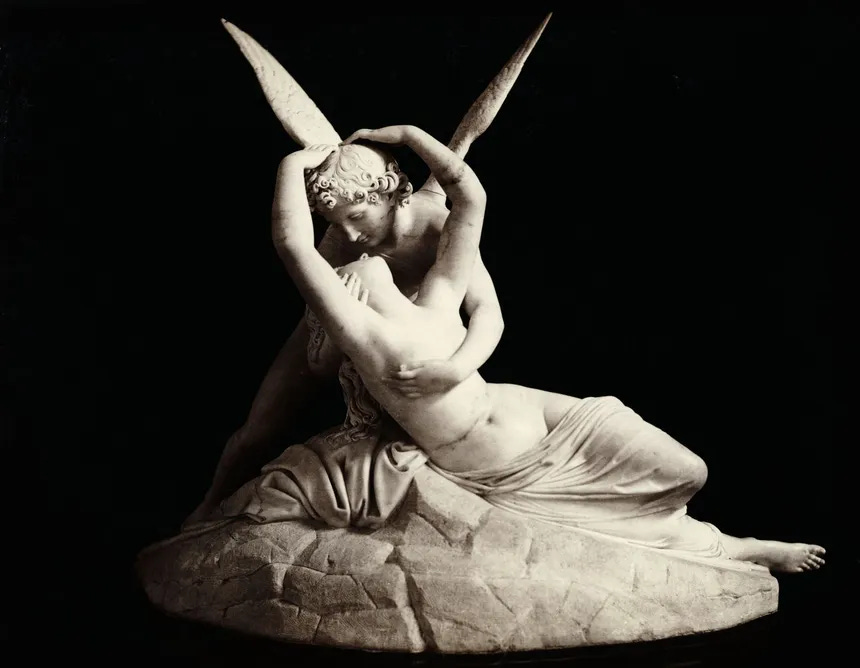
According to the ancients, love manifests itself through Eros, the primordial force of attraction that unites opposites to fill our voids and bring us back to a single, undifferentiated and total entity. In particular, in Hesiod's Theogony, Eros is one of the protogons, i.e. the primordial deities from whom the universe springs, symbolising the creative and unifying power of life.
This article does not aim to examine Eros or Love itself, but rather to reflect on their tripartite division according to Indo-European metaphysics: three modes of expression that reverberate in the myths and rituals of ancient societies.
Tripartite division of love according to functions
It is well known that the Bhagavad Gita illustrates three modes (guṇa) - sattva (purity/virtue), rajas (passion) and tamas (ignorance) - corresponding respectively to the first, second and third functions. Similarly, Georges Dumézil, investigating the myths and rituals of Indo-European peoples, identified three social functions (sacred, warrior, productive) that reflect three ethos. In his Indo-European Marriages, he analyses wedding rites and emotional relationships in ancient societies, without, however, explicitly dividing love into three types of emotions. In this post, I adopt a modern language that is respectful of ancestral concepts.
Dumézil describes an Indo-European society divided into three functions - sovereignty, warfare and production - and we can extend this structure to the modes of love:
Sovereign (sacred) function: hierarchical and devotional love, based on mutual respect and recognition of the other as the bearer of a higher order. In Vedic mythology, the union between Agni (sacred flame) and Svaha (deity of offerings) symbolises the sacrificial bond that makes contact between the human and the divine possible; in Germanic mythology, the bond between Odin and Frigg evokes fidelity and respect for sacred roles.
Warrior function: passionate and assertive love, which drives people to conquer and transform reality in order to assert themselves and others. Emblematic examples are ritual abductions such as that of Helen by Paris in Greek tradition, or the Celtic myth of Fionn mac Cumhaill, which, albeit in different circumstances, combines amorous audacity and martial valour.
Productive function: everyday and procreative love, which manifests itself in care, alliances and cooperation for the benefit of the group. The myth of Pururavas and Urvashi in the Vedic tradition tells the story of a bond based on rules and mutual gifts, while in Slavic mythology, the marriage between Svarog (god of fire) and Lada (goddess of fertility) enshrines tribal prosperity and harmony.
Although referring to social classes and deities, each function conveys an ethos that we also find in interpersonal relationships.
Passion as warrior energy
“Passion” corresponds to the warlike function: in Indo-European myths, it is not condemned but exalted as a dynamic force. Ritual abductions, such as that of Devaki by Kamsa in the Krishna cycle or the abduction of Proserpina by Pluto in Roman mythology, symbolise the warrior's ardour and the amorous determination of the second function. These stories tell not so much of violence as of the concept of conquest as an act of mutual transformation.
Daily care and reciprocity (third function)
The third function, linked to productivity and fertility, is expressed through mutual gift-giving and alliances: dowries, tributes and ritual exchanges strengthened family and tribal ties, ensuring stability and prosperity. In many Indo-European cultures, the dowry ritual - as in the Iranian tradition with the lab-khandan - represented a sacred offering rather than a mere economic agreement. Similarly, in totemic funeral banquets among the Balto-Slavic peoples, the sharing of food and drink consolidated alliance pacts.
Functional order and modern visions
Dumézil does not use terms such as “meritocracy” or “corporatism” in their current sense, but describes an order in which each individual - priest, warrior or producer - performs their function in harmony with others. It is a normative hierarchy based on complementarity rather than unbridled competition. In Latin myths, the order of the gods (Jupiter, Mars, Quirinus) reflects this balance exactly: each god exercises his power for the good of the community.
Love of virtue
Love of virtue is considered the highest form of love: a partner is chosen for their intrinsic qualities, not for material advantages. This form of love, selfless and platonic, is found in the first function. A literary example is the concept of dharma in the epic Mahābhārata, where respect for values guides the most authentic unions.
Passionate love
In the warrior dimension, passionate love is a driving force: when channelled towards virtue, it promotes individual and couple growth. Consider the bond between Gilgamesh and Enkidu, in which friendship and vital ardour lead to a profound transformation of both.
Everyday love
Finally, everyday love - the third function - manifests itself in mutual care, rituals of gift-giving and bonds that strengthen social cohesion. It is not a simple economic exchange, but a system of solidarity and mutual support. The tales of Cernunnos' domestic sacrifices in Celtic tradition emphasise the value of family and tribal care.
This tripartite division provides an ordering framework in which each function, respecting its own nature, contributes to the harmony of the community fabric rather than fuelling competition at the top.