

This article features a translation of an article provided by Serenissima News, which will be expanded upon and include our commentary.
Having already written an article on the Battle of Lepanto (or Battle of the Cursołare, as Venetian historians call it), we want to explore its triggering episode: the Ottoman Siege of Famagusta, a tragic event that ended in martyrdom, exemplifying the nature of the Venetian Republic’s defense of its Stato da Mar - its Mediterranean possessions.
In writing this article, we drew from two of the best contributions on this topic: the Venetian historian Alvise Zorzi’s La Repubblica del Leone (“The Republic of the Lion”), and the Genoese journalist and writer Arrigo Petacco’s L’Ultima Crociata (“The Last Crusade”). Two passionately written but authoritative books that we highly recommend you read.
As mentioned above, we also based this article on the contribution of Serenissima News, translating it in English and expanding upon it. You can read the italian version here.
Before proceeding with the narration of the Fall of Famagusta, we need to quickly reference the historical context of the events that were about to happen, as well as the life of the one who would lead the defense of the fortress: Marcantonio Bragadin.
Historical context
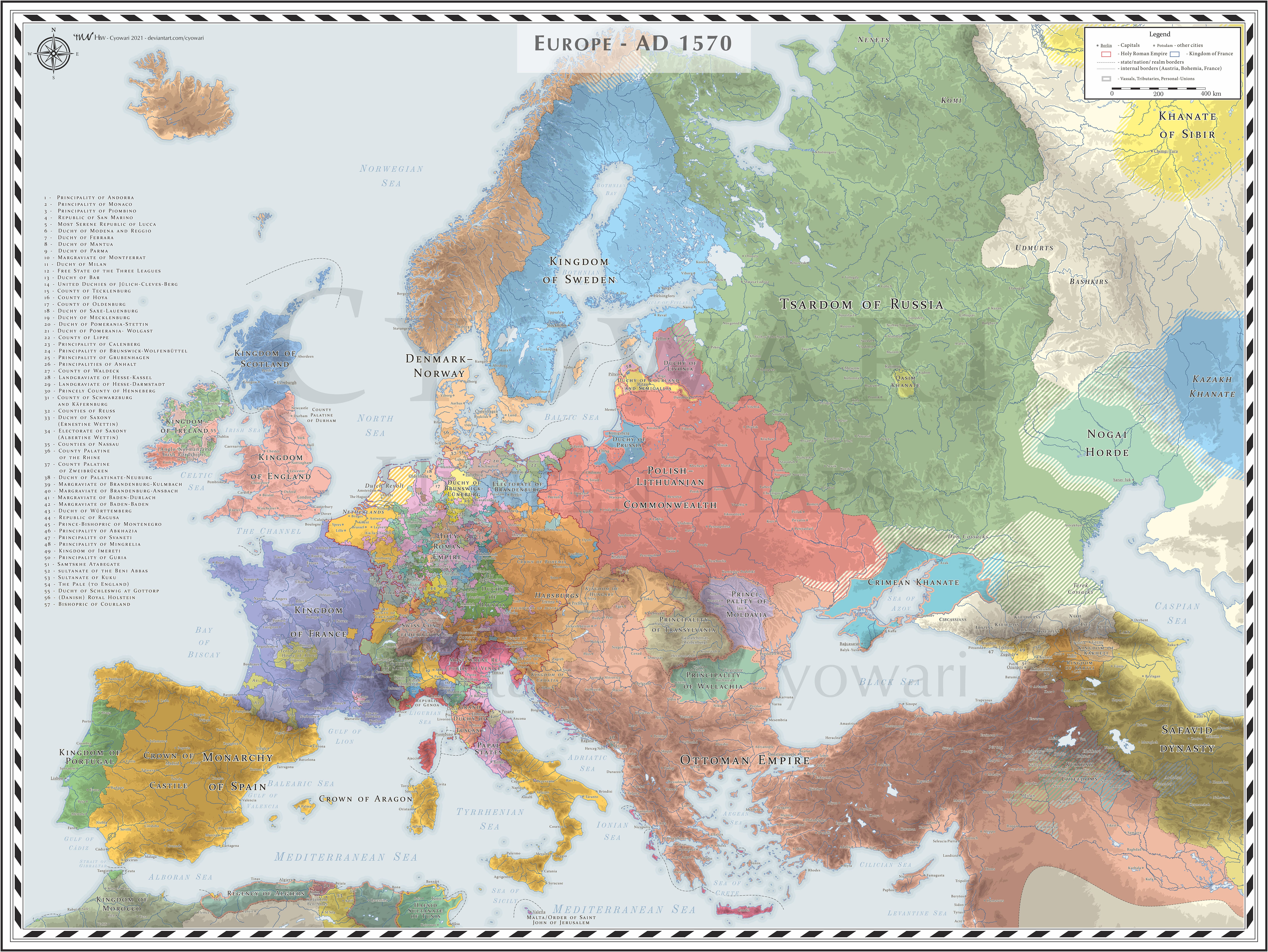
In the turbulent 16th century, Europe was in the midts of profound political and religious changes, shaken by the advent of the Protestant Reformation, internal conflicts, and rivalries between the great Christian powers. In this scenario, the Mediterranean became the focus of tension between the Ottoman Empire and Christian Europe, culminating in one of the bloodiest and most significant wars: the War of Cyprus.
The protagonists of this conflict were the Venetian Republic on one side - the first and last line of naval defense against Ottoman expansion - and the Ottoman Empire on the other, led by Sultan Selim II.
Selim II and his secret advisor
Suleiman the Magnificent’s successor, Selim II, was not a leader of the stature of his father. Famous for his alcoholism, which earned him the nickname ‘el mest’ (the drunkard), he was a sultan far removed from the image of the conquering warrior. Yet his territorial ambitions remained grandiose, fuelled by two key figures: Grand Vizier Mehmed Sokolli and Joseph Nassì, also known as Joseph Micas, a Portuguese Jew with a dark past who became one of the most influential men at the Ottoman court.
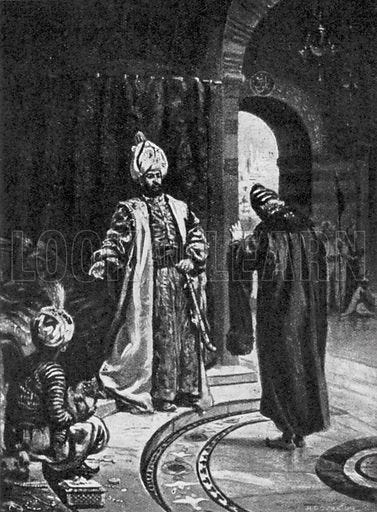
Expelled from Spain and exiled from Venice, Joseph Nassì had found refuge and influence in Constantinople, where he nurtured a dream of creating a homeland for persecuted Jews. His plan was to colonise Cyprus, not only for commercial reasons related to the island’s famous wine, but also to make it a safe haven for Jews. Nassì’s interest in Cyprus dovetailed perfectly with that of the Grand Vizier Sokolli, who saw the island as an essential strategic base for the expansion of Ottoman influence in the eastern Mediterranean.
Although the two men had different motivations, their shared ambitions gave rise to a military campaign that would shock Europe.
The European context and the fragility of Venice
As the Ottoman Empire prepared its campaign, Christian Europe was caught in a moment of extreme vulnerability.
Spain, ruled by Philip II, was embroiled in the struggle against the Moors, the Muslims who remained on the Iberian peninsula after the Reconquista, and was facing numerous internal revolts. France and the Netherlands were torn apart by religious wars between Catholics and Protestants. In this context, the Venetian Republic, although powerful at sea, was essentially isolated, with few allies and limited resources to defend Cyprus, one of its most valuable and strategic possessions.
The coup de grace for Venetian security came in September 1569, when an explosion almost completely destroyed the Venetian Arsenal, the centre of its naval power. Many believe that Ottoman agents were behind the attack, part of a plan orchestrated by Nassì to weaken the Serenissima’s naval power and prepare the ground for an invasion. At the same time, bands of Turkish pirates commanded by Kara Ogia and Occhialì (a Calabrian-born admiral who converted to Islam and would fight Venice for decades), plundered the Venetian islands in the Adriatic and even threatened the shores of Venice itself.
Venice, though alarmed, proceeded sluggishly to strengthen the island’s defences, resolving to take energetic measures only after the Sultan’s intentions had been openly revealed in the spring of 1570. But it was too late to enable Cyprus to repel the looming Ottoman army.
Nevertheless, the defenders prepared energetically to face the attack, under the command of perhaps the best man for the job: Marcantonio Bragadin.
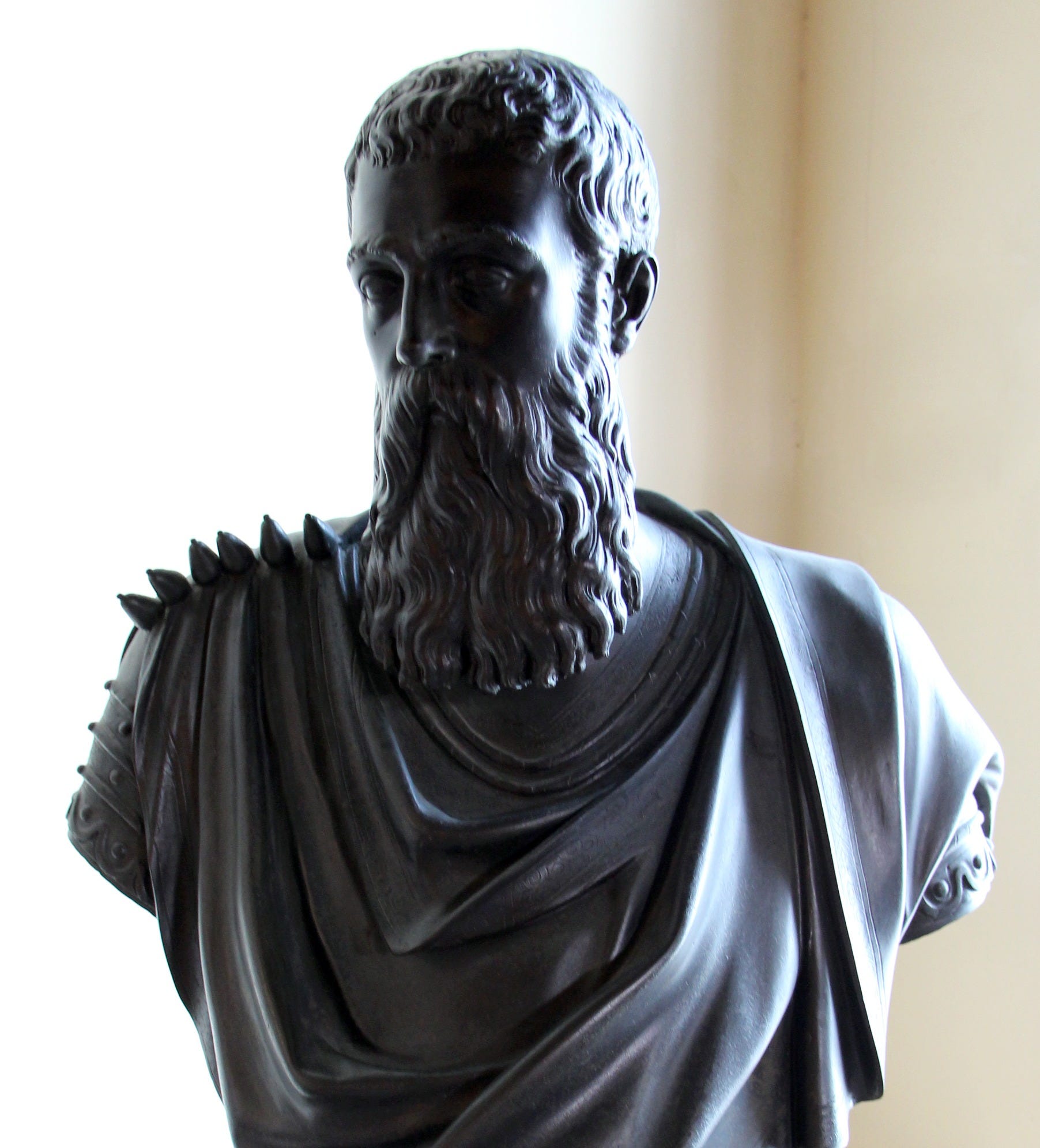
Marcantonio Bragadin’s early life and career
Marcantonio Bragadin was born in Venice on 21 April 1523 to Marco di Giovanni Alvise and Adriana, daughter of Giovanni Bembo, into a middle-class patrician family. His social status and domestic customs destined him for a career in the judiciary and the navy.
His father had risen to the modest office of Provveditore sopra Camere; his older brother Giovanni Alvise had served in the navy as a galley captain before entering the city’s judiciary. Of his other brothers, Giovanni, who would die in 1558, had been councillor of Cyprus and Provveditore al Cottimo in London; Andrea was Provveditore sopra Camere, Savio agli Ordini, and finally an officer in the Messettaria; Antonio, finally, would command one of the six Venetian galleasses which, with their firepower, played a decisive role in the Battle of Lepanto.
After a brief stint as a lawyer in the offices of Rialto in 1543, Bragadin embraced a career at sea, becoming deputy governor of a galley, then in 1550 “patron di fusta” and finally captain of a galley. Returning to Venice and marrying Elisabetta di Almorò Morosini in 1556, he devoted himself to serving in the city’s offices, being elected in 1556 as Provveditore to the Chamber of Loans, in 1561 to the Rason Vecchie and in 1563 to the Dieci Savi sopra le Decime.
However, the courage, energy and sense of duty he demonstrated in the army meant that he was still destined for military positions. Twice, in 1560 and 1566, he was again appointed governor of the galley fleet, but then, as there was no longer any reason to arm the fleet, Bragadin did not actually take command.
Finally, on May 31st 1569, the Senate elected him Captain of the Kingdom of Cyprus1, an office based in the city of Famagusta, which in normal times was entrusted with the military government of the island.
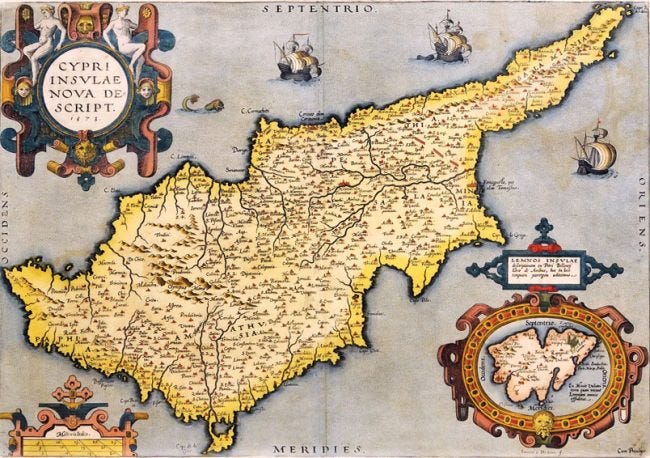
When Bragadin reached Famagusta, not before September (a letter written during the journey is dated from the galley in the waters of Corfu on August 26th 1569), the first reports began to arrive of the great military preparations undertaken by the Turks for an imminent expedition, whose true objective remained shrouded in secrecy for several months.
The Siege of Famagusta
The Ottoman landing on Cyprus
In charge of defending Famagosta, where the first Turkish landing was expected, Bragadin set about fortifying the city, supplying it with food, storing gunpowder in secure depots, and enlisting militias paid with copper coins minted in the local mint, imposing their use by threatening the death penalty for those who refused to accept them, so that, according to one chronicler, “said coin circulated as if it were gold and silver”.
Bragadin certainly possessed all the courage and ruthless energy that the situation required, to the point that during the siege - for reasons unknown but probably for some serious act of insubordination - he drew the sword from the side of a company captain and killed him with his own hands.
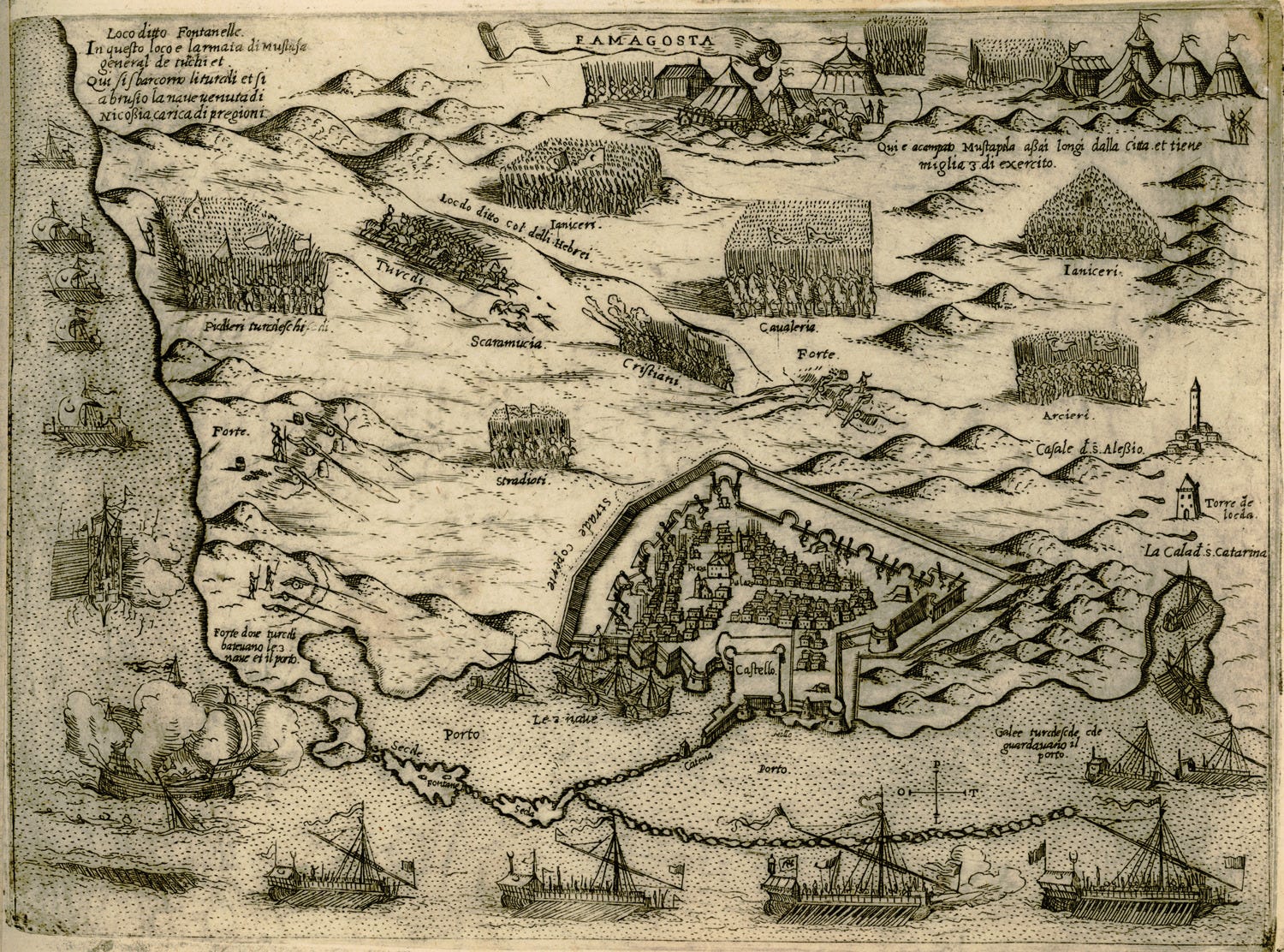
In July 1570, the Ottoman Empire launched a major offensive against Cyprus. A fleet of one hundred and twenty galleys, led by Piyale Pasha, landed on the island with an army of one hundred thousand men under the command of General Lala Mustafa, and simultaneusly blockaded the port. This effectively cut the Venetians off from large-scale reinforcements or supply by sea.
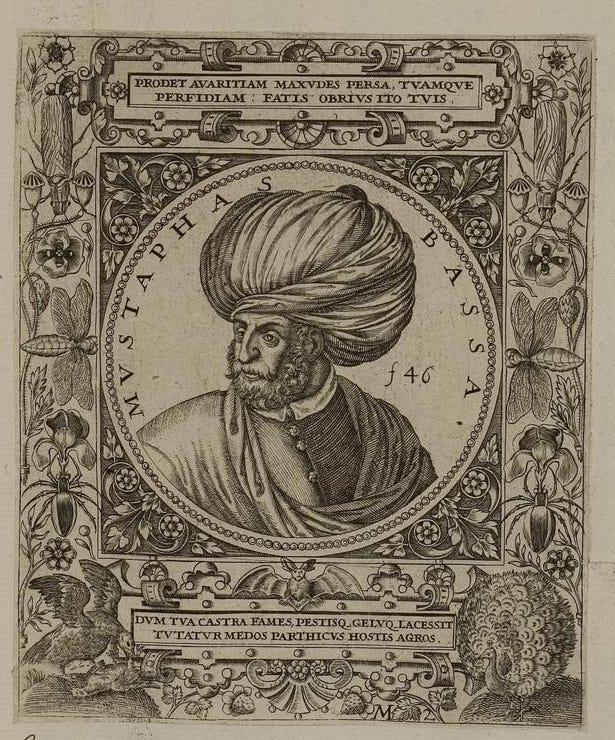
They encountered no resistance as they disembarked, and marched first on Nicosia, the capital of the island. The city would fall after seven weeks of siege, during which the Venetian lieutenant (the civil governor) Nicolò Dandolo tried in vain to resist. The capitulation of Nicosia ended in a massacre: over 20,000 people were killed, while thousands of boys and girls were enslaved and deported to Ottoman harems or sold on the slave markets.
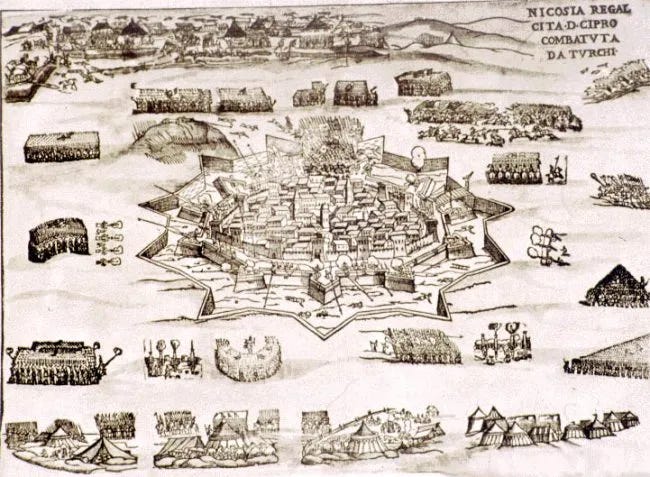
Lala Mustafa would send a grim announcement to Bragadin on September 11th: the head of Niccolò Dandolo, the commanding officer of Nicosia, along with a demand for the surrender of Famagusta. Bragadin replied:
“I have seen your letter. I have also received the head of the lord lieutenant of Nicosia, and I tell you herewith that even if you have easily taken the city of Nicosia, with your own blood you will have to purchase this city.”
The fall of Nicosia was the first tragic step towards total control of the island: having conquered the capital, the Ottomans marched on Famagusta, the last major Venetian stronghold on the island.
The desperate resistance of Famagusta
From then on, while the garrison of Cerinea Castle capitulated in terror without a fight, the heroic resistance of Famagusta began, animated for eleven terrible months by Bragadin’s firm will.
His behaviour was not an isolated episode of valour, nor was the resistance a vain sacrifice. Some of the laurels of Lepanto must also go to the defenders of Famagosta. Located over 2.250 km from Venice, they had just 8,500 men with which to defend the city - outnumbered ten to on by the besiegers - while help from the Holy League was nowhere in sight.
It seemed that the Venetians, fighting at sea and in the Levant, rediscovered the military valour and efficiency that they seemed to have lost in the wars in Italy, but that so many Venicean patricians continued to pass down from generation to generation by sailing on merchant galleys and in the navy. Religious sentiment and the awareness of a deadly clash between two irreconcilable civilisations instilled an unusual ardour in the hearts of the combatants.
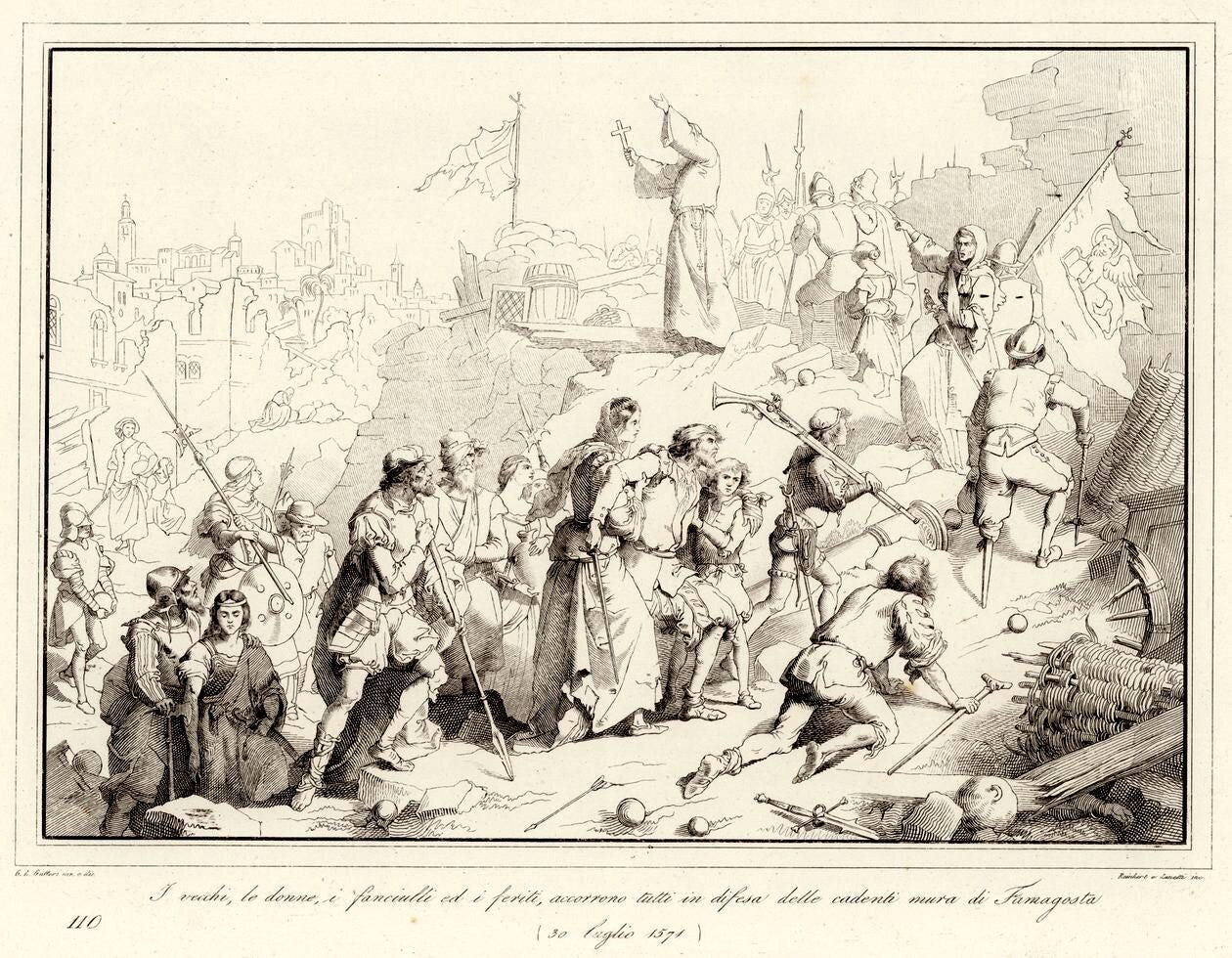
The Ottomans launched repeated attacks, digging trenches and building tunnels under the city’s fortifications. Their forces were almost inexhaustible, but each assault was repulsed with heavy casualties. Thousands of Turkish soldiers fell into the pits around the walls of Famagusta, forming veritable bridges of corpses across which their comrades attempted to advance. In total, more than 50.000 Ottoman soldiers would die during the siege.
Bragadin left no stone unturned in his efforts to solicit aid, sending Bishop Ragazzoni to Venice on November 5th with Nicolò Donà’s galley and begging his relatives in several letters to do the same, “being sure,” he wrote, “that I will be helped by all for the universal benefit and mine in particular”. He could even delude himself that Venice was prepared to take extreme measures, if on 15 February 1571 he urged his family to go to the Doge to encourage him to come in person with the army “to reclaim this Kingdom, which will be the cause of defeating everyone who comes against it.”
But beyond these hopes, he was sustained by his sense of duty and unwavering dedication to his ideals in life, which he was able to express in the rough prose of a man of action unaccustomed to writing.
In letters written during the siege to his mother-in-law and brothers-in-law of the Morosini family, he fervently asked them to pray to God: “and whatever befalls me, His divine goodness will find me ready to suffer death and other scourge, being as prepared as possible in His grace, I will not fail, through any accident, to do my duty to my prince, where you can all be sure that whatever one like me can do, I will do, as I have done in the past”.
Despite minor successful attempts at providing aid in the early months of the siege, Bragadin and his men were forced to rely on grass and their mounts to survive, but they never lost hope. Waiting for help from Venice - which seemed imminent - fuelled their resistance, but help was slow in coming. In January 1571, a Venetian fleet led by Marcantonio Querini managed to temporarily break the Ottoman blockade and bring supplies and ammunition to the city. But this was only a brief respite for the defenders.
The repeated arrivals of the (meager) reinforcements, provisions and ammunition, and the expectation of a counter-offensive by the Venetian and Christian armies, also gave rise to reasonable, albeit unfounded, hopes of success.
Deeply involved in the political affairs of his city, Bragadin was content in those circumstances to complain that he was not being sent news of the elections to the councils and magistrates. His concern for his family caused him great suffering: “It pains me,” he wrote on March 11th 1571, in the last letter to his family that has come down to us, “to think of the thoughts that those who love me have of me”; but he urged them to remain ‘cheerful and of good will’: “for every hour I am more satisfied to find myself here on this occasion, hoping and holding it as certain that my illustrious House will follow whatever is desired of me”.
Resolved in this spirit to resist to the end, Bragadin rejected repeated demands for surrender by the Turks, who had been encamped around the city since September 17th of the previous year, and were closing in on it with trenches, batteries and mines. Encouraged by Bragadin and Astorre Baglioni, governor general of the island’s militia, who were tirelessly present on the ramparts with weapons in hand at the most critical moments, the defenders put up deadly fire and made daring sorties for as long as possible.
The Fall of Famagusta
For many long months, hardly a day passed without fighting, until June 21st, when a large mine was detonated under the walls, and the Turkish army launched its first general assault. On June 29th, another mine opened the way for the enemy to attempt a new mass attack.
Perhaps as early as July 2nd - if Captain Angelo Gatto’s report is accurate - the bishop of Limassol, on behalf of the citizens, begged for surrender negotiations; but Bragadin, having gathered the people together, urged them to resist for at least two weeks, giving them hope that help would soon arrive.
Meanwhile, the bombardment and attacks gave the defenders no respite, and on July 9th and 14th they were hit by two more general assaults, with which the Turks managed to wedge themselves into the fortified walls.
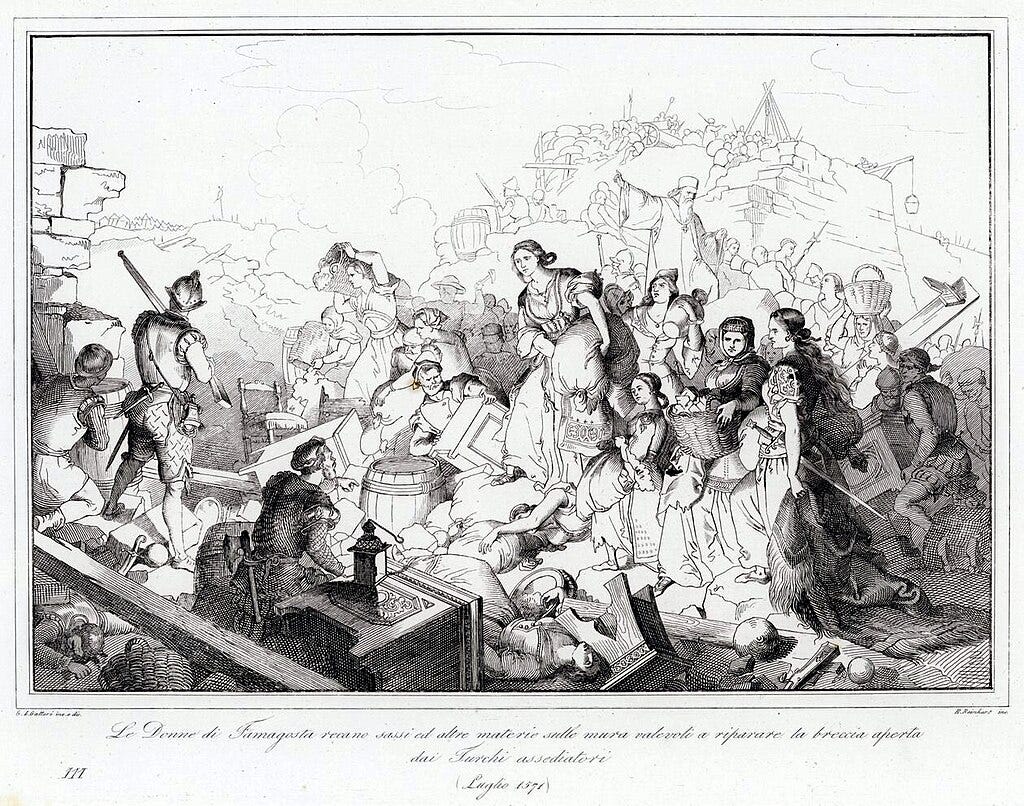
Thus, July 20th arrived, and everyone - citizens and soldiers alike - saw no other escape than surrender; yet they did not dare mention it to Bragadin. But when he was finally informed, ‘he rose from his chair shouting angrily, saying: “God forbid that Bragadin should ever do such a thing, and whoever dares to tell me such a thing again, I will take his life”’.
According to the testimony of Alessandro Podacataro, to the proposals for surrender he replied that, once the supplies were exhausted, he would rather “take the Crucifix in his hand and go out into the countryside, confident that, as soldiers of valour and honour, they would follow him, and thus gloriously end their misery and their lives, gaining the kingdom of heaven”.
It is difficult to separate the bare truth from the suggestions that the strong figure of Bragadin, exalted by martyrdom, may have exerted on the memory of the witnesses of those events in these and other testimonies. But what Bragadin’s state of mind really was at that moment is revealed in the last dispatch he managed to send on July 19th.
The message, also signed by Lorenzo Tiepolo and addressed to the Doge, the captain general of the army and the Venetian commanders in Candia, was less an extreme plea for help than a manly acceptance of a fate that was now sealed.
Despite the heavy losses suffered, the survivors had defended themselves in good spirits, sustained by the confidence that the promised reinforcements would arrive; but now, Bragadin warned, the frightened population was expressing a desire to surrender, while among the soldiers, convinced that they had been abandoned to their fate, discouragement was spreading.
Without complaints or useless recriminations, Bragadin realised that Famagosta’s fate was now sealed: he sent a frigate with the message, not in the hope that it would arrive in time to solicit help, “but rather to gratify some of those who had sought it, thinking that this would lift the spirits of some of those who were upset”.
The defenders held out for another twelve days, repelling three new general assaults, and Bragadin refused to even consider surrender. Only on the evening of July 31st, after a day of fierce fighting at the end of which the Turks, who had penetrated the city through the large breaches in the half-destroyed walls, were repelled in a desperate effort, with supplies and ammunition exhausted (only seven barrels of powder remained) and only a few hundred men left, Bragadin had to bow to the firm opinion of Astorre Baglioni and the other military leaders, who were in favour of negotiating a honorable surrender with the besiegers.
The Martyrdom
The following day, August 1st, the terms were signed, allowing the defenders to retreat to Candia (Crete) with the civilians, their weapons, and five pieces of artillery. On the evening of August 5th, once the embarkation was complete, Bragadin, together with Baglioni and the other Venetian commanders, went to the Turkish camp to hand over the keys to the city.
The reception was initially cordial, but soon Lala Mustafa Pasha abruptly changed his tone and violently attacked Bragadin, accusing him of having slaughtered fifty Turkish prisoners the previous night. Bragadin vigorously denied the accusation, but to no avail. Two letters intercepted later by the Venetians, one from Mustafa Pasha himself and the other from his secretary, show that the Turk had learned of the massacre from prisoners who had escaped from Famagusta that night, and had coldly prepared his revenge.
Whether the news of the massacre is true is difficult to ascertain. Certainly, it would not be surprising. And perhaps, on the other hand, Mustafa was looking for nothing more than a pretext to break the agreements and vent his anger against the defenders of Famagosta, who for almost a year had pinned down the Turkish army under the city walls, inflicting heavy losses on it.
Thus, Mustafa ordered the Christians to be tied up. Bragadin’s ears were immediately cut off, then he was forced to watch the beheading of his companions, Venetian officers who played a leading role in the epic defense of Cyprus. Thus died men whose valour was already legendary throughout Europe: Alvise Martinengo, Astorre Baglioni, Gianantonio Querini, and Andrea Bragadin.
After a short imprisonment, Bragadin’s martyrdom was completed on August 17th. Already seriously ill from the infection of the horrible wounds inflicted on his head, he was dragged through all the besiegers’ batteries and forced, amid jeers and lashes, to carry two heavy baskets of earth to the trenches. He was then imprisoned in a minuscule cage and hoisted onto the mast of a galley moored in the harbour and kept suspended for twelve days, suffering grievous sunburns.
Finally, he was led with blows of a stick to the square of Famagosta. When he collapsed lifeless on the ground, he was promised his life would be spared if he converted to Islam. Bragadin refused, and was then tied to the pillar of torture, where the executioner began to skin him alive. Bragadin did not cease to recite the Miserere prayer and invoke the name of Christ until, after they had flayed his chest and arms, he breathed his last.
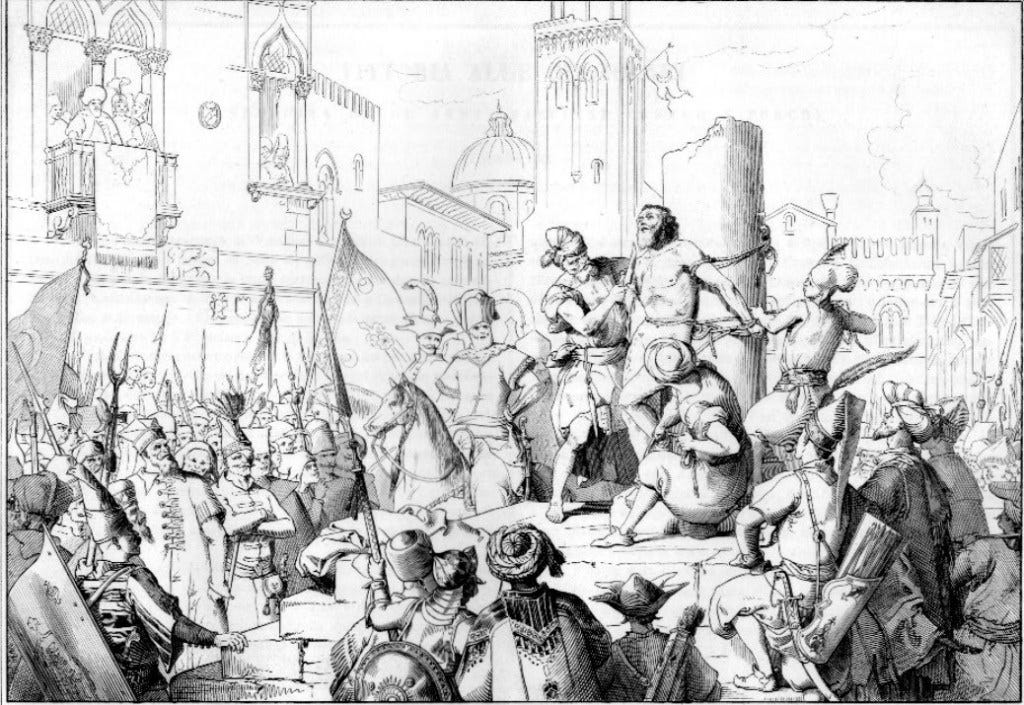
The body was then quartered, and his skin, stuffed with straw and cotton and dressed in the clothes and insignia of command, was carried in a macabre procession through the streets of Famagusta and displayed as a trophy on the city’s walls. It was then hung from the mast of a galley, which took it to Constantinople together with the heads of the Christian leaders.
Upon hearing the news, the public in Europe - but especially in Venice - erupted in anger and sadness. The manner of Bragadin’s execution, combined with the fall of Famagusta, had a profound impact on Venetian public opinion, fueling anti-Ottoman sentiment.
The fall of Cyprus marked not only the end of Venetian rule on the island, but also a turning point in the struggle between Christianity and the Ottoman Empire, likely contributing to the formation of the 1571 Holy League that defeated the Ottoman fleet at the famous Battle of Lepanto. Although this victory did not return Cyprus to the Venetian Republic, it stopped Ottoman expansion in the Mediterranean and became a symbol of hope for Christian Europe.
The Battle of the Cursołare

It is really difficult for us to talk about the Battle of Lepanto. This is because in the content we bring you, we always try to add that extra something that can give depth to the subject. For many of the events we have told you about so far, it is easy to find material on the web, either in Italian or in Venetian, but it is often presented as a mere c…
Bragadin’s Legacy
The sacrifice of Bragadin and his men was not forgotten. In 1580, a young Venetian sailor, Girolamo Polidori, discovered the martyr’s stuffed skin in a dusty arsenal in Constantinople.
“The skin was folded to a size of a sheet of paper, solid and palpable as a napkin; they could see his chest hair still attached, and on the right hand, which was flayed, was a nail that still seemed alive.”
Recognizing it, he managed to steal it and smuggle it out of the city, bringing the last remains of famed Bragadin to their home in Venice, where he would be posthumously honored as a hero and a martyr. His skin was interred with full honors in the Church of San Zanipolo in Venice, where a monument was erected in his memory.
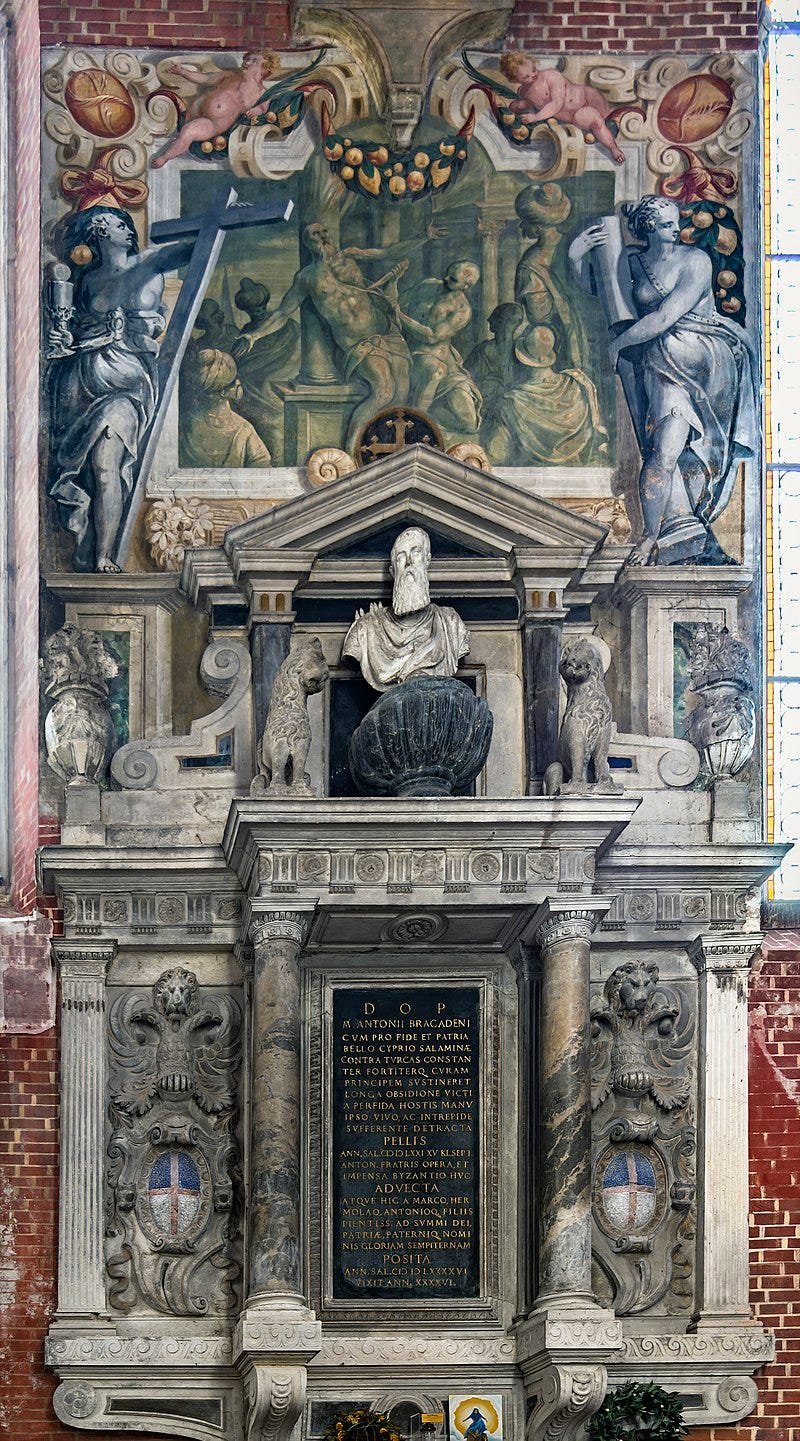
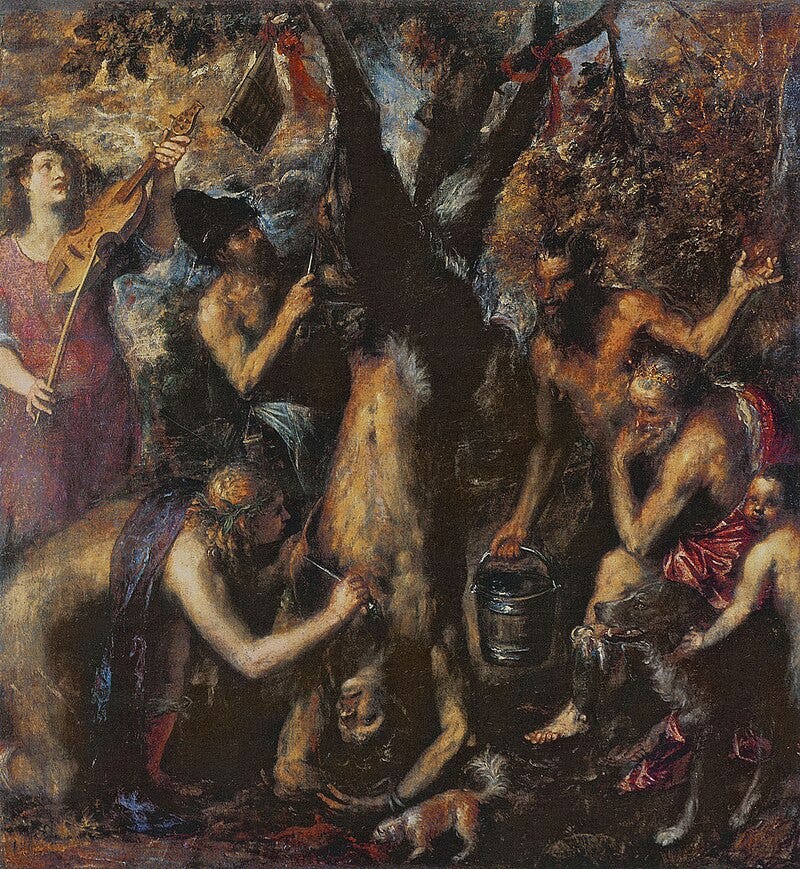
The legacy of Marcantonio Bragadin’s would be immortalized in art, literature, and public memory. For example, Titian’s Flaying of Marsyas is said to have been directly inspired by Bragadin’s martyrdom.
This tragic yet inspiring episode of Venetian history is a testament to how strength of will and sense of duty can drive people and groups to push beyond their limits, to achieve things that seemed impossible. This strength is needed, today more than ever.
Venice governed Cyprus as a colonial Kingdom without a king. The Republic ruled through a Luogotenente del Regno di Cipro (civil governor in Nicosia) and a Capitano di Cipro (military commander in Famagusta), both appointed from Venice. The Doge claimed the style of Lord of Cyprus, but real power rested in these Venetian officials and the Senate.
Consiglio il bellissimo romanzo storico “Bragadin” di Sergei Tseytlin e “Accadde a Famagosta” di Gigi Monello, che cita fonti e testimonianze dirette dell’assedio e della guerra di Cipro