It’s easy to think of 15th-century Venice as a “Mediterranean” power: galleys in the Levant, convoys to Alexandria, the Adriatic as a home sea. But that picture is incomplete: Venice’s commercial imagination already stretched far beyond the Strait of Gibraltar, towards England and Flanders through the long, risky Atlantic route that connected Mediterranean capital to the markets of Northern Europe.
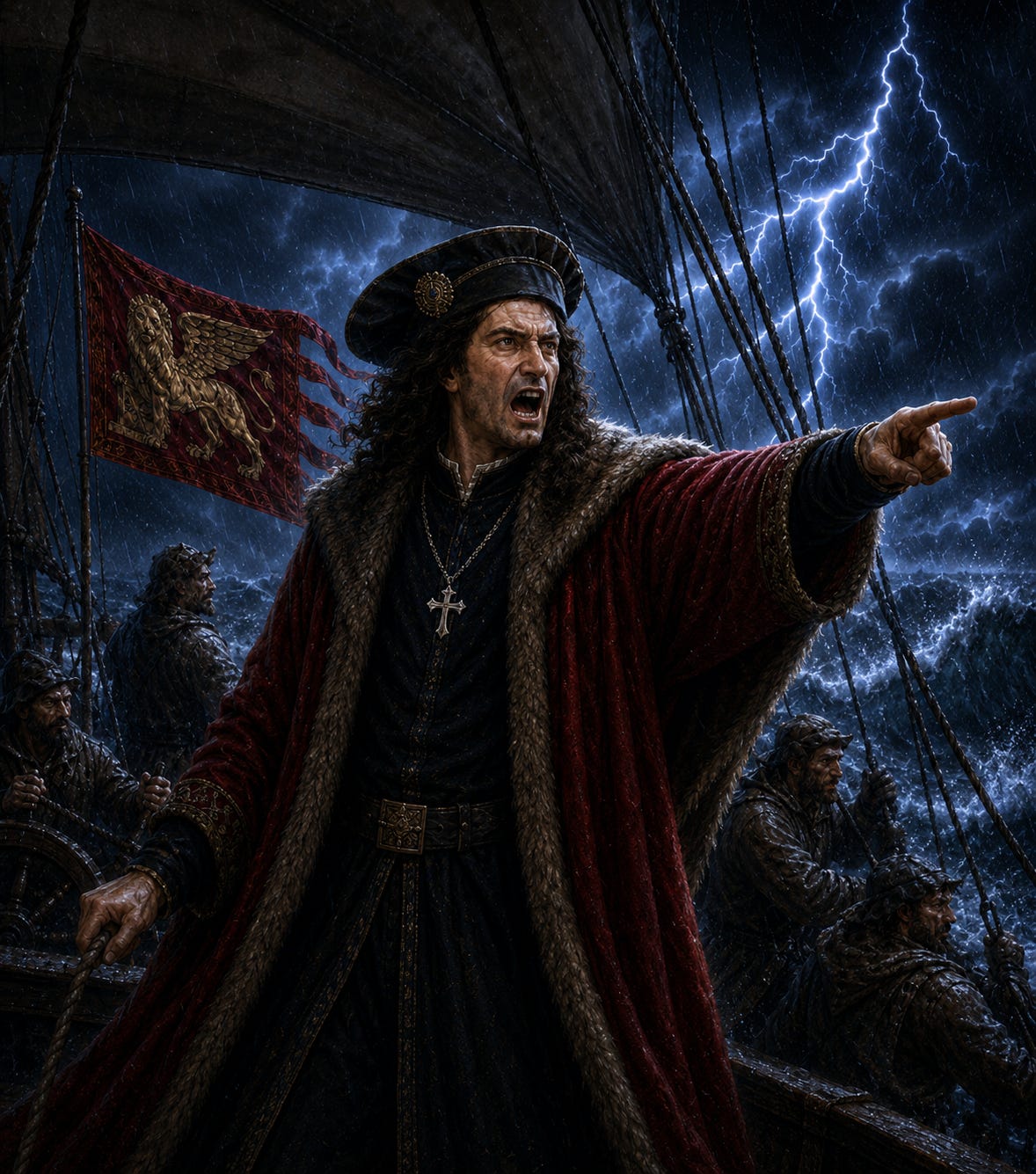
AI image of Piero Querin. Altough there are different putative portraits on the internet, there are no official or confirmed portraits of him.
Piero Querin (Venice, ca. 1400 - Venice, 1448), italianized Pietro Querini, would have never expected to become the model for relations between Venetia and the Nordic regions. He wasn’t even an “explorer” in the modern sense. His pioneering quality lay instead in combining private commercial initiative with a detailed record of an economy unfamiliar to most of Southern Europe. He was a Venetian patrician operating within the hard logic of maritime trade: plan a voyage, load a profitable cargo, protect it as best you can, and accept that the sea can turn any plan into wreckage. Eventually, the storm struck, leading to the unlikely outcome of him being shipwrecked beyond the Arctic Circle, among the outer islands of Lofoten. A (mis)adventure that he recounted in minute detail to the Venetian authorities
A naval disaster became documentation, and documentation became history. And it is thanks to Querin’s accounts that we are able to follow the day-to-day progress of his adventure.
A Textbook example of a Venetian patrician
Querin belonged to the patriciate that governed the Republic and also drove its trading system. In that world, being a nobleman meant being a businessman: access to capital, credit networks, ships, and the legal tools to move goods at scale. Querin’s 1431 voyage began in Candia (Crete), then a major Venetian possession and one of the Republic’s best logistical platforms in the Eastern Mediterranean. It was most likely his first trip—or at least his first to a land as far away as Flanders—and he wanted to ensure the success of the venture by setting sail himself.
He also had direct interests on the island, as he held the castles of Temisi and Dafnes, connected to the production of Malvasia, a wine that could be moved as high-value cargo to northern markets, toward Flanders. The ship was a large merchant vessel: a cocca called Querina, described as a cypress-wood ship of about 445 tons, a serious vessel for its time. The crew counted 68 men of different nationalities.
Querina’s cargo comprised 800 barrels of Malvasia at departure, alongside spices, wax, rock alum, and other goods. These were exactly the kind of high-value and portable commodities that made the long-distance voyage worth the risk. But arrival is not a given in the Atlantic. The moment Venice’s ships exit the relatively calm Mediterranean waters, they enter a completely different environment.
From Voyage to Wreckage
Querin sailed from Candia on 25 April 1431, only a few days after the death of his son, an emotional shadow over an already demanding enterprise. From there, the plan was to reach the Atlantic, run northward, and eventually make for Flanders. Instead, the ship was battered into a sequence of delays and deviations.
A first serious setback forced the Querina to stop at Cadiz on 2 June 1431, where it required repairs. Only on 14 July could the ship resume its voyage. Even then, contrary winds pushed it off its intended path toward the Canary Islands, where it remained for roughly 45 days - a loss of time that implied rising costs and a loss of morale.
Eventually the Querina reached Lisbon on 29 August 1431, and departed on 14 September. Later, it stopped at Muros (Galicia) on 26 October. Despite the accumulated delays, Querin is said to have taken the opportunity to visit Santiago de Compostela.
Then, on 5 November 1431, a violent storm began to drive the ship off course. Around 10 November, the rudder was finally lost, initiating a long drift in the Atlantic. Weeks went by, in which the ship was hostage to wind, current, cold, and dwindling provisions.
By mid-December the situation was untenable. On 17 December 1431, the crew abandoned the ship in boats. One of them disappeared. The other - carrying Querini and a portion of the survivors - continued northward through the wintry sea.
On 6 January 1432, sixteen survivors landed on Sandøya in the Lofoten archipelago, beyond the Arctic Circle. Five died before help arrived. On 3 February 1432, the remaining eleven castaways were spotted and taken to Røst, a remote island community at the outer edge of Lofoten. There they remained for 3 months and 11 days, through the final part of winter and into spring, surviving thanks to the organisation and hospitality of a small fishing society whose economy was structured around seasonal cod fishing.
Querin and his companions left Røst with stockfish and, more importantly, with knowledge. Tradition connects Querin’s shipwreck to the later diffusion of stockfish in Venetian cuisine. The surviving evidence, however, does not show that he opened a new trade corridor or personally introduced the product to Venice: stockfish already circulated through an established northern European network. His account is better understood as an early and detailed Venetian testimony to that trade. Mai mołar (“never give up”): even catastrophe could be converted into experience and memory.
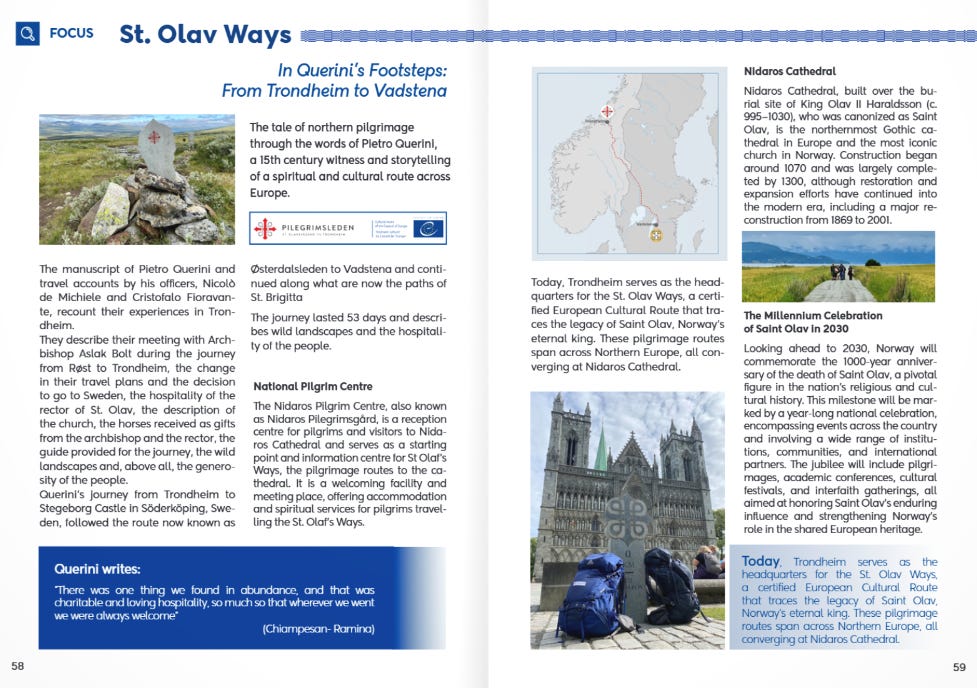
The group left Røst on 14 May 1432 and reached Trondheim, where the survivors visited the sanctuary of St. Olaf. They then travelled through Sweden, reaching Vadstena. After a stay at Stegeborg, they returned to Vadstena near and arrived at Lödöse on 7 August 1432.
At Lödöse, the group split for logistic reasons. Three of Querin’s companions went toward Germany (via Rostock) and eventually reached Venice on 12 October 1432. Eight, including Querin, headed toward England, and Querin eventually returned to Venice in January 1433. Almost two years for a commercial voyage that was never meant to last even a fraction of that time.
Back from the Dead
By the time Querin reappeared, Venice had good reason to assume he was lost at sea. When he showed up he presented a report to the Venetian Senate, an account that survived in manuscript tradition (notably in Vatican holdings). Another important narrative, attributed to Cristoforo Fioravante and Nicołò de Michiel, was dictated later and preserved in Venetian manuscript collections.
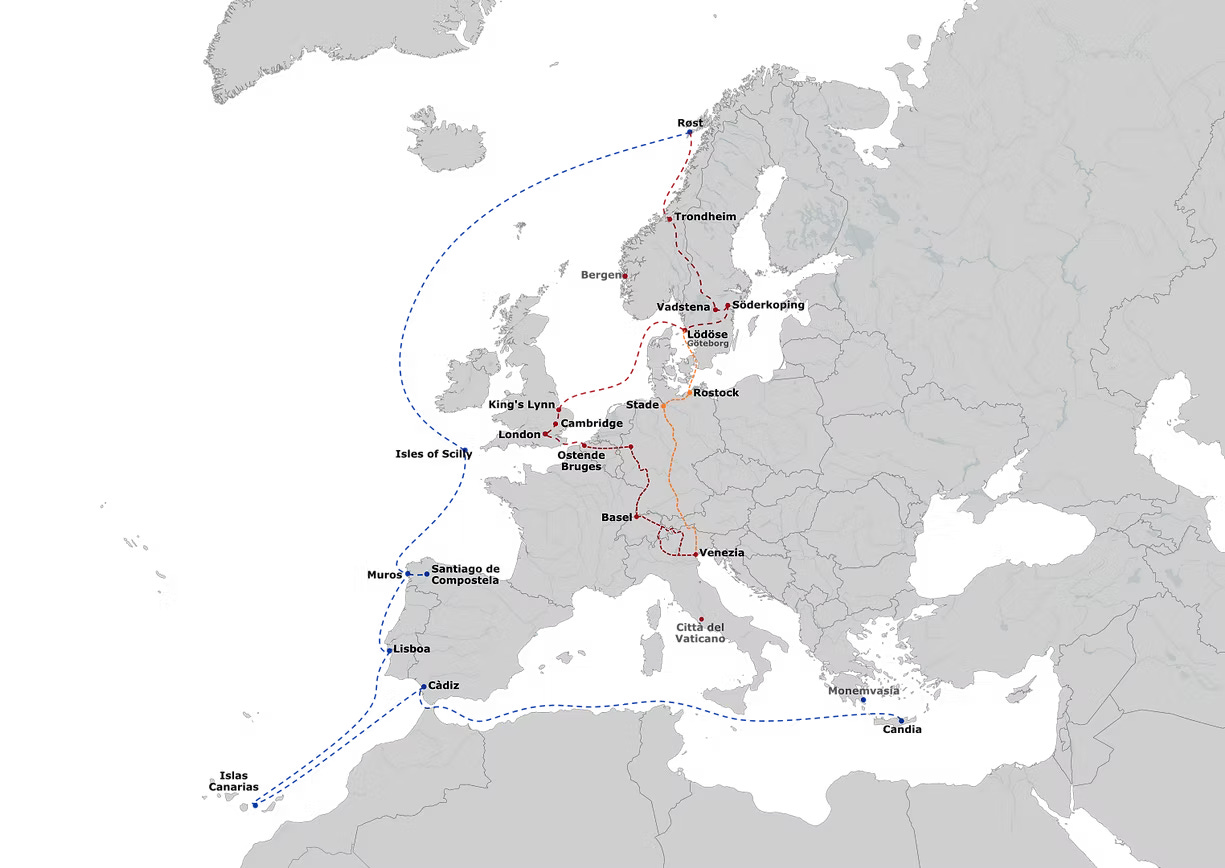
In blue the outward journey by sea, in red the Pietro Querini ‘s return journey by land. In orange Cristofalo Fioravanti and Nicołò de Michiel’s return journey. Credits to viaquerinissima.net
Both accounts would later be published in a revised form by Zuan Batista Ramuzio (Giovan Battista Ramusio) in his famous collection of voyages. He was the author of one of the earliest and most important systematic collections of travel accounts of the modern era called Delle Navigationi et viaggi (On navigations and voyages).
Querin’s Arctic journey would have remained confined to a note in the Venetian archives and buried in a library forever. Thanks to his detailed account, it went down in history.
The birth of the bacałà
Røst’s economy revolved around cod. The islanders’ key technique was preservation: drying cod into stockfish, a product that could be stored and transported over long distances without spoiling and was already embedded in an established northern trade. The Venetian navy was particularly advanced when it came to sailors’ diets; for example, it was among the first to include citrus fruits in its food supplies to combat outbreaks of scurvy. For Venetian merchants, a durable source of animal protein was commercially attractive. Querin’s encounter with stockfish, however, may not have been the event that triggered the spread of bacalà throughout the Venetian lands, but it may have paved the way for a previously unknown market.
Origin of the word
The etymology of the Venetian bacałà shows clearly how culinary words are often the result of trade routes rather than simple linguistic lineages. The Venetian term does not appear to have arisen locally, but belongs to a broader European family of related words - Italian baccalà, Spanish bacalao, Portuguese bacalhau, Catalan bacallà, Basque bakailao, Dutch kabeljauw/bakeljauw - connected to the northern and Atlantic trade in preserved cod.
The ultimate origin of the bacal- root remains disputed: some hypotheses link it to the Flemish-Dutch area, others to Basque or Iberian mediation. The specifically Venetian peculiarity is semantic: while in standard Italian baccalà usually means salted cod and stoccafisso means dried cod, in Veneto bacałà often refers precisely to stockfish, as in bacałà a la visentina and bacałà mantecato.
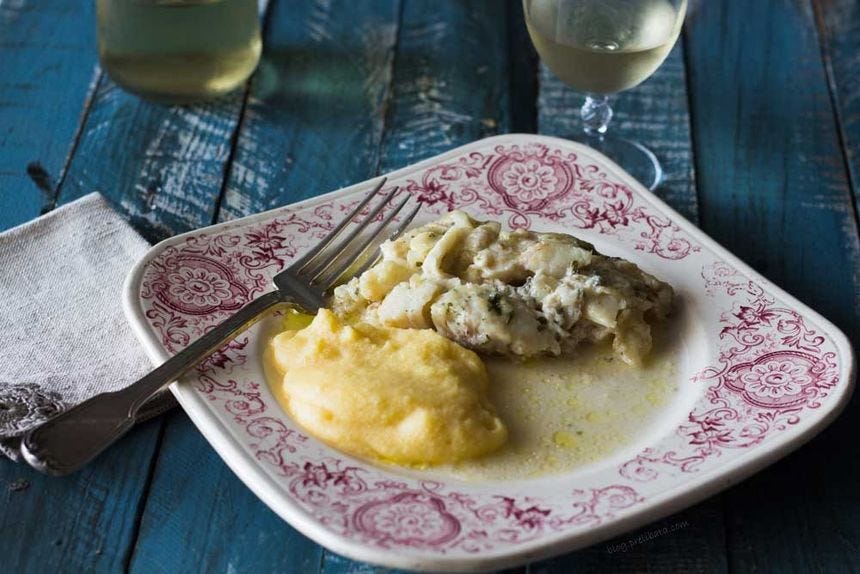
Bacałà a la visentina, traditional dish from Vicenza with stockfish and polenta.
The most known variation is bacałà a ła visentina, traditionally associated with Vicenza and its countryside. Made with stockfish, it begins with a long rehydration: the dried cod is beaten, cleaned, opened, boned and soaked in cold water for two or three days, with frequent water changes. Once softened, it is cut into pieces, lightly floured, layered in an earthenware pot with slowly fried onions, salted sardines or anchovies, and parsley, then covered with milk and extra virgin olive oil. It is cooked over a very low flame for four to five hours without stirring; instead, the pot is gently moved in a circular motion, a local technique known as pipare, so the fish remains intact while the sauce thickens around it.
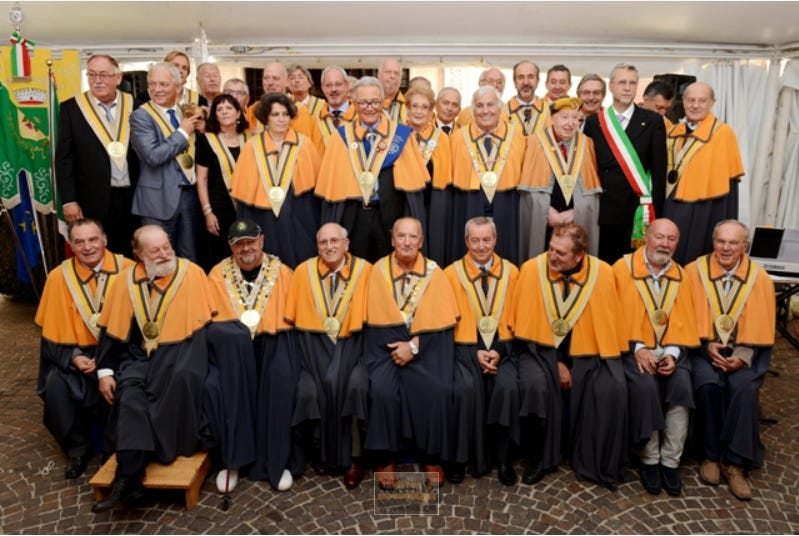
The traditional recipe is upheld in Sandrìgo by the Venerable Confraternity of Bacałà
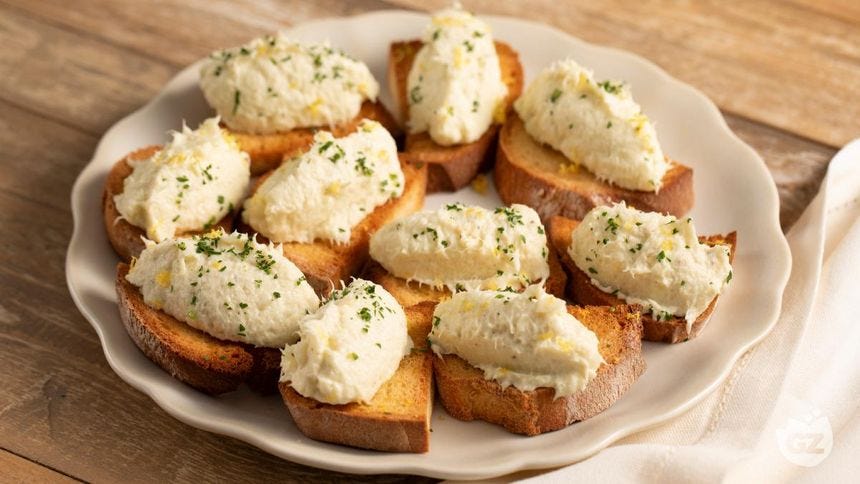
Venice developed a different expression of the same base ingredient: bacałà mantegà. Here the stockfish is gently cooked until tender, then beaten with olive oil, garlic and sometimes parsley until it becomes pale, creamy and spreadable, with a texture closer to a mousse than to a stew. Unlike the Vicentine version, it belongs above all to the Venetian culture of the cicheto: served in small portions on toasted bread, grilled polenta or white polenta, and eaten at the counter of a bacaro with a glass of wine. Its character lies in concentration: a few bites of intense flavour, soft texture and maritime memory.
cicheti de bacałà mantegà, traditional Venicean snack.
Whether as a main meal or a snack, bacałà earned its place in the traditional cuisine of Veneto.
Querin’s Legacy
Fra Mauro’s World Map
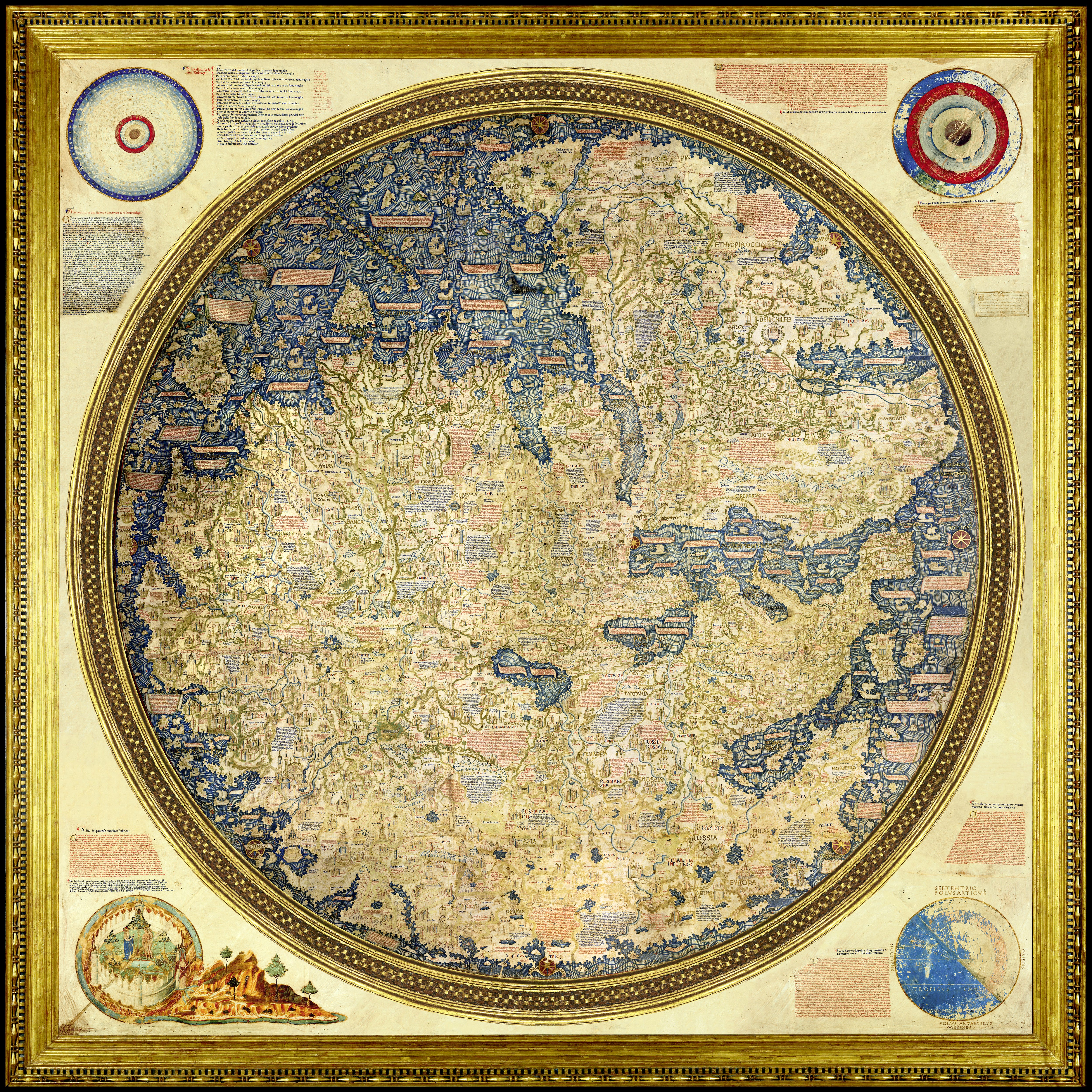
Fra’ Mauro’s World Map, dating from around 1450, is one of the most valuable—and best-known—artifacts preserved in the Marciana Library in Venice.
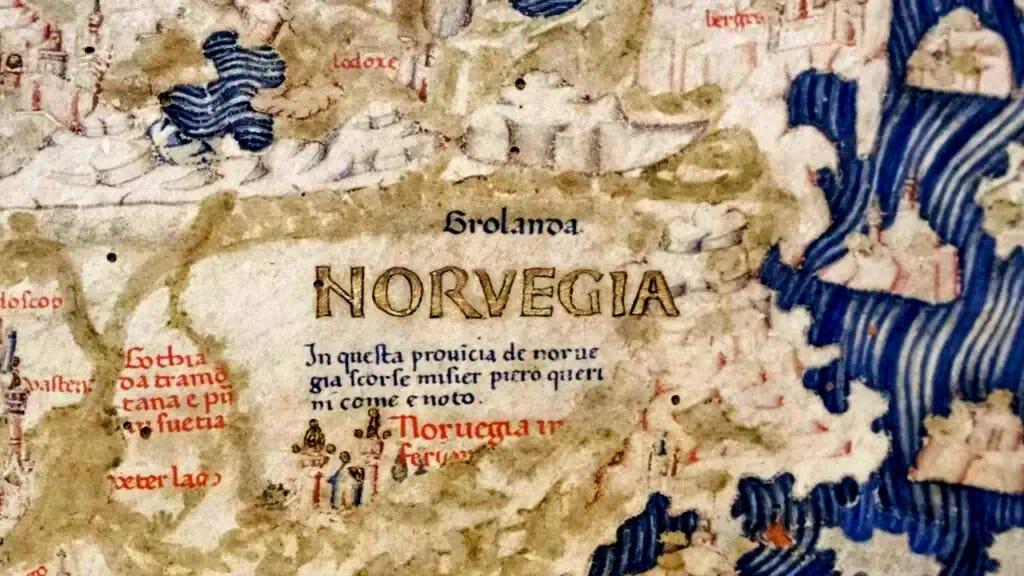
On Fra Mauro’s map, under the name NORVEGIA, you can read: “In this Norwegian province, as is well known, Piero Querini went.”
On the celebrated mapamondo de Fra Mauro, preserved in Venice, an inscription mentions Querin’s passage in Norway, essentially stating that “in this province of Norway Messer Piero Querin travelled, as is known.” It’s tempting to imagine Querin personally meeting Fra Mauro and narrating the story directly. That’s plausible, but it’s not documented.
Via Querinissima Cultural Route
In the 21st century, the inheritance of Piero Querin has taken a new institutional and territorial form in the Via Querinissima. Initially created through a partnership between the regions of Veneto and Nordland, based on the direct historical and symbolic link between Venice and the island of Røst, the project has gradually grown into a trans-European itinerary involving partners from Greece, Italy, Spain, Portugal, Norway, Sweden, the United Kingdom and the Holy See.
The route traces the maritime journey of the Querina and the long journey of the survivors back through Europe, linking places such as Heraklion, Cadiz, the Canary Islands, Lisbon, Muros, Santiago de Compostela, Røst, Trondheim, Vadstena, Lödöse, King’s Lynn, Cambridge, London, Bruges, Basel, Rostock and Venice. Via Querinissima sees each stage not as a uniform series of destinations but as a separate chapter in a common European history of navigation, commerce, pilgrimage, shipwreck, hospitality and cultural exchange. It also connects maritime and overland routes, so that the sea is at the heart of the itinerary not as a barrier between regions but as a medium of connection.
It is wider in its reach than the historical memory or gastronomic legacy of stockfish. In Via Querinissima Querin’s journey becomes a way to explore the enduring cultural, commercial and food traditions which connect southern and northern Europe. Thus Malvasia in Crete and stockfish in Norway, Venetian bacałà become part of a larger cultural geography that also encompasses Atlantic ports, Scandinavian landscapes, commercial cities and spiritual centres such as Santiago de Compostela, Trondheim and Vadstena.
The project promotes slow, sustainable and regenerative tourism, inviting travellers to experience local identities, landscapes and traditions rather than consume a series of destinations. The main values of the route: solidarity, hospitality, resilience and cultural exchange, are taken directly from the historic experience that is being commemorated: a Venetian crew saved by a distant northern fishing community and brought home through a network of religious institutions, merchants, local rulers and ordinary families.
Via Querinissima is also considered as a tool of territorial cooperation. Initiatives like the Via Querinissima Days provide local institutions and communities with the opportunity to promote regional excellence, create international networks and develop projects adapted to the specific character of each territory. The historical itinerary thus becomes a forum where local identities can collaborate without being dissolved into a generic European uniformity.
In this sense the Via Querinissima is a contemporary monument to the Venetian European civilisation: maritime, pragmatic, curious, disciplined and open to exchange without losing its own form and identity. In the strictest sense, Piero Querin was a failed merchant adventurer. But in the longer history of Venetia he succeeded, as few men do, in turning catastrophe into knowledge, memory and inheritance.
Thanks for reading Third Venetia.
Sources
F. Giliberto, G. Piovan, Alla larga da Venezia - l’incredibile viaggio di Pietro Querini oltre il circolo polare artico nel ‘400, 2008
Alberto Quartapelle, “The shipwreck of the Venetian Pietro Querino at the Lofoten Islands (Norway) in 1432,” Terrae Incognitae 57, no. 1 (2025): 5-59.
These accounts of Venice and the huge impact of Venetian trade at this time are so fascinating. My 16th Great Grandfather was Coriolano Cippico (1425-93), a Dalmatian nobleman from Trogir in Croatia. He wrote a book ( still available) called The Deeds of Commander Pietro Mocenigo which details an eyewitness account of the Christian-Ottoman confrontation in the late fifteenth century and how the empire of Venice actually worked. It’s well worth reading the book( I got not copy from amazon). Thank you for a brilliant article!



These accounts of Venice and the huge impact of Venetian trade at this time are so fascinating. My 16th Great Grandfather was Coriolano Cippico (1425-93), a Dalmatian nobleman from Trogir in Croatia. He wrote a book ( still available) called The Deeds of Commander Pietro Mocenigo which details an eyewitness account of the Christian-Ottoman confrontation in the late fifteenth century and how the empire of Venice actually worked. It’s well worth reading the book( I got not copy from amazon). Thank you for a brilliant article!