

A City Between Worlds
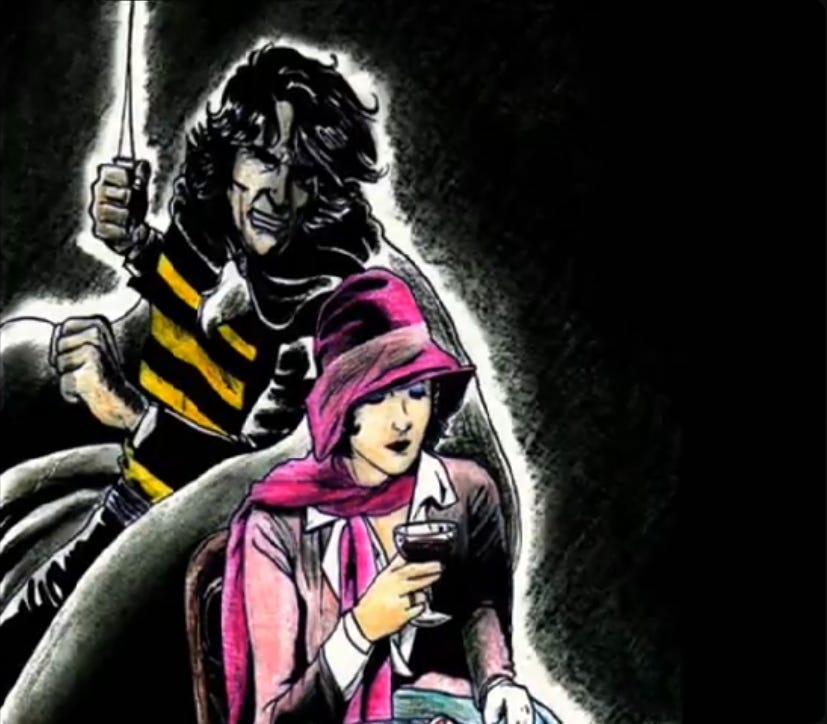
Trieste in 1932 was a cosmopolitan port city at the crossroads of Venetian, Slavic, and Germanic cultures, still navigating the social disruptions of the post-Habsburg era. Against a backdrop of shifting gender norms and a younger generation moving through public space with unfamiliar freedom, the conditions were ripe for the figure who would become known as the Omo Vespa, the Wasp Man.
The First Sting: Via Carducci, 7 March 1932
In the early hours of 7 March 1932, Maria Forza—a bartender finishing her night shift at the Caffè Procuratie in Piazza Goldoni—noticed a man following her through the empty streets. He caught up with her at the corner of Via Carducci and struck her on the left flank with a pointed instrument before vanishing into the darkness. The wound, examined at the Ospedale Regina Elena, was superficial; Forza herself ruled out robbery or personal vendetta. The attacker had taken nothing. He had simply stung.
The following morning, Il Piccolo—Trieste’s principal daily—ran the story under a headline that would frame the entire episode:
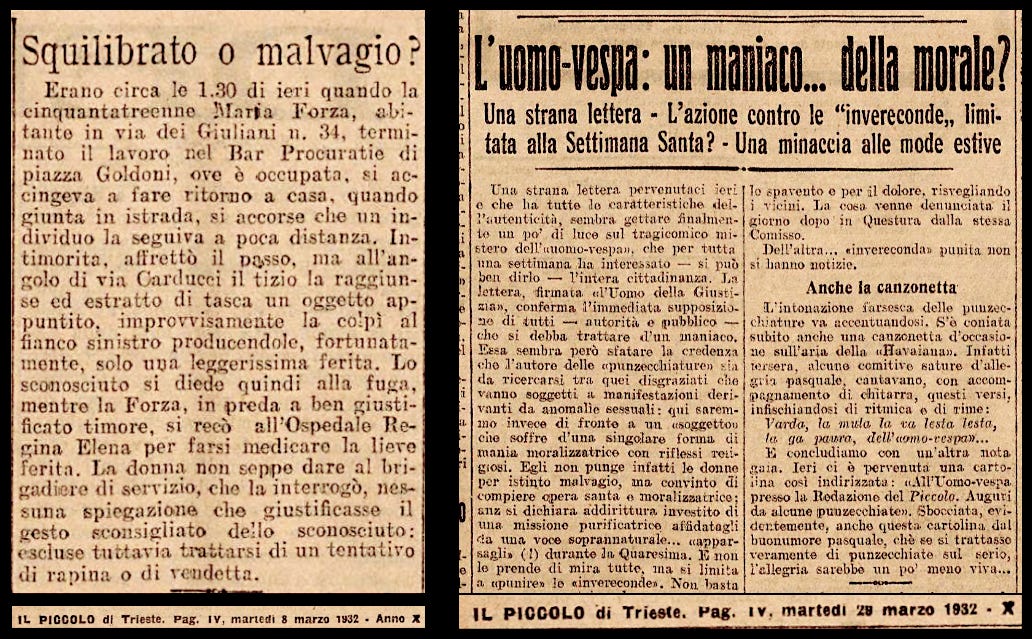
Disturbed, or wicked? The distinction was not merely rhetorical. It asked whether the Omo Vespa was a man acting on compulsion—or one acting on conviction.
The Escalation
For two weeks the city remained tense. Then, on the night of 20 March, five young women were pricked in a single night in the alleys of the Cittavecchia. Il Piccolo, whose crime reporter Flaminio Cavedali became the episode’s chief chronicler, published a rapid succession of alarmed headlines: “L’uomo-vespa, altre quattro ragazze punzecchiate!” (24 March); “L’uomo-vespa acciuffato?” (24 March, evening edition). National newspapers followed, and the panic spread as far as Gorizia and the surrounding region.
Nocturnal citizens’ patrols were organised; the city’s medieval underground tunnels were searched; a tinsmith named Giacomo Ziuch even presented himself at Il Piccolo to seek backing for a patented “paraspunte”—a zinc buttock-guard he had designed for the city’s women. The whole affair had acquired the character of a collective psychosis: later analysts, including the Italian skeptical science organisation CICAP, have situated the episode within the documented pattern of mass psychogenic illness, in which named, personalised threats generate genuine fear responses and a proliferation of reported incidents well beyond the original stimulus.
The Letter
On Easter Sunday, 27 March, a letter was posted in the city centre and subsequently published by Il Piccolo on 29 March. Its author claimed to be the Omo Vespa himself:
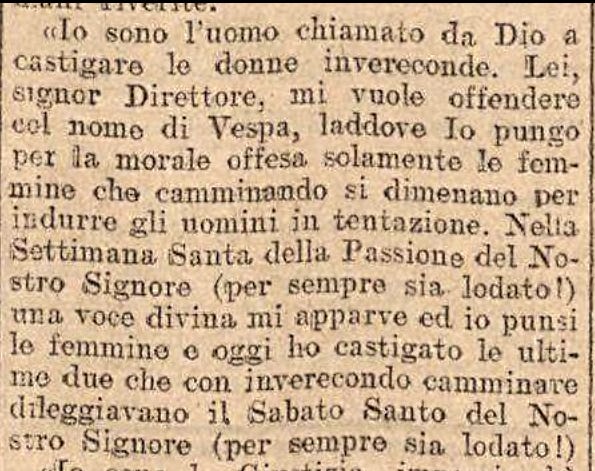
“Io sono l’uomo chiamato da Dio a castigare le donne invereconde... io pungo, per la morale offesa, solamente le femmine che camminando si dimenano per indurre gli uomini in tentazione.” — Letter attributed to the Omo Vespa, Il Piccolo, 29 March 1932
English:
“I am the man called by God to chastise shameless women... for the sake of offended morality, I smite only those women who sway as they walk, leading men into temptation.”
He styled himself a “fustigatore della pubblica immoralità”—a flogger of public immorality—and announced a seasonal suspension of his campaign, with the promise to resume at the first signs of immodest summer dress. Whether the letter was written by the attacker himself or, as some historians suspect, embellished or even composed by Cavedali, it transformed the Omo Vespa from a criminal into a cultural figure: a villain with a manifesto.
Parallel Figures Across Europe
The Omo Vespa was neither unique nor unprecedented. Across the European world, a tradition of the anonymous phantom pricker—and the social panics he generated—stretches back at least two centuries:
England (1788–1790) — The London Monster. Similarity: attacked over fifty women in central London with concealed blades, targeting the buttocks and thighs; generated vigilante patrols, false accusations, and women adopting protective undergarments. Difference: his attacks were more violent and caused lasting wounds; he was eventually tried and imprisoned, though historians question the conviction.
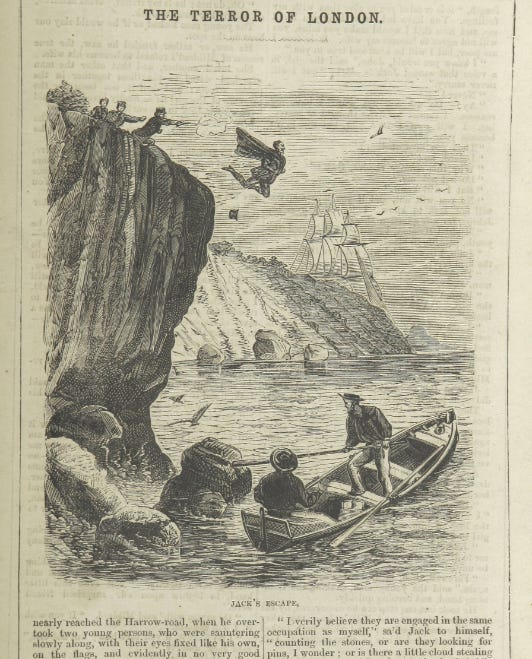
England (1837–1904) — Spring-Heeled Jack. Similarity: a cloaked phantom attacker of women in urban alleyways who inspired press hysteria, civic alarm, and vigilante groups; never captured. Difference: his legend rapidly acquired supernatural dimensions—fire-breathing, impossible leaps—which the Omo Vespa’s never did; he became a penny-dreadful antihero precisely through this mythologisation.
England (1938) — The Halifax Slasher. Similarity: a supposed razor-wielding attacker in a northern English town who generated Scotland Yard intervention and street patrols. Difference: several alleged victims were eventually found to have self-inflicted their wounds, making this one of the clearest documented cases of a phantom attacker generated almost entirely by collective suggestion.
France (1922) — The Paris Piqueurs. Similarity: anonymous needle-wielders reported by thousands of Parisian women over two months in late 1922, with identical modus operandi to the Omo Vespa. Difference: no single named figure emerged; the episode remained diffuse and was not personalised through a letter or a folk song.
What sets the Omo Vespa apart from all these comparators is the letter—the explicit, written declaration of a moral programme. No other figure in this tradition stepped into the public record to explain, in his own words, why he was doing what he was doing.
The Antihero’s Grammar
The Omo Vespa fits the template of the antihero with uncomfortable precision. Like Zorro—who operates outside the law to enforce a justice the law cannot deliver—he acted on a coherent internal code, chose restraint (he stung; he did not slash), and cultivated a relationship with the public even while evading its institutions. He did not rob. He did not kill. His chosen weapon was calibrated to sting, not wound. His self-description as “l’uomo chiamato da Dio” places him in the lineage of the self-appointed moral enforcer—a vigilante of propriety.
The popular response was characteristically ambivalent, as responses to antiheroes always are. Alongside genuine fear, there was widespread amusement: adolescent boys staged mock pricking incidents; Ziuch’s zinc buttock-guard was as much a civic joke as a commercial proposition. The city was simultaneously frightened and entertained by its invisible corrector of public morals—a figure perceived as villain by the law and as dark comedian by the street.
The Song
Within months of the episode’s conclusion, Flaminio Cavedali—the very journalist who had covered the attacks—adapted the lyrics of the popular 1929 melody “Tommy” (by Cherubini and Di Lazzaro) to create “L’Omo Vespa,” a folk song in Triestine dialect that has never entirely left the city’s repertoire. Reissued in a folk-rock arrangement by singer-songwriter Lorenzo Pilat on his 1978 album Io Trieste, it introduced the Omo Vespa to subsequent generations.
An Unresolved Identity
The Omo Vespa was never caught—or, if caught, his capture was never made public. The attacks ceased abruptly in April 1932, without explanation. Speculation attached his identity to the religious communities of the Cittavecchia: a Franciscan friar from the convent of Piazza Rosmini, a Jesuit from the college on Via Ronco. Some believed the police had quietly arrested him and suppressed the news to avoid civic unrest. Others maintained he had simply melted back into the ordinary life of the city, resuming the anonymity from which he had briefly, strangely emerged.
A single oral account, collected in 2001 from an elderly woman who had lived through the events as a girl, describes an encounter near Piazza Barbacan: a dark figure emerging from a courtyard entrance, beginning to give chase, then abandoning pursuit as his intended victim reached her doorway. By the time the account was recorded, the woman was in her nineties. Memory and legend had had seven decades to settle into each other. Whether what she recalled was the Omo Vespa, or the city’s idea of him, is a question that—like the man himself—may never be answered.
Conclusion
The Omo Vespa endures because he occupies the space that cities reserve for their most Triestine of creatures: ironic without being cynical, transgressive without being murderous, morally certain in a city that has always made its living from productive uncertainty. He believed. He acted. He disappeared. And in disappearing, he became permanent.
Sources
Il Piccolo (Trieste): contemporary reports, 7–29 March 1932, cited in secondary literature.
Query Online / CICAP: “Trieste, 1932: la psicosi dell’uomo-vespa,” 23 June 2021.
Bora.La: Lorenzo Pilat (”René”), “La vera storia dell’Omo Vespa” (2009); “L’Omo Vespa… ottant’anni e non sentirli” (2012).
Jan Bondeson, The London Monster: A Sanguinary Tale (University of Pennsylvania Press, 2002).
Robert Bartholomew, Little Green Men, Meowing Nuns and Head-Hunting Panics (Prometheus Books, 2001).
https://www.scenacriminis.com/delitti-biografie-criminali/attacchi-uomo-vespa-il-pungitore-di-ragazze/