

Friulian is certainly an interesting case study. A Romance language spoken almost exclusively in present-day Friuli (even though it was once spoken across a wider area), it has absorbed numerous influences from surrounding languages while retaining archaisms that continue to be debated by linguists. Friulian is a perfect reflection of Friuli itself: a land that is both a crossroads and isolated. A gateway to the Italic, Slavic, and Germanic worlds, Friuli is closely guarded by its native population, who are the descendants of the Carni and Veneti mentioned in Roman sources, as well as the Lombards.
Despite its distinctive linguistic evolution, the Italian state did not recognise the Friulian language until 1999. This was accompanied by a hasty revision of school textbooks. It was also accompanied by the far-fetched justifications of the sociolinguists of the time. This academic recognition was, in fact, political, and followed the independence movements in Veneto and Lombardy. These movements were represented North League, whose founder Umberto Bossi recently passed away. Italy could not afford to have a border region threatening to secede, so it granted Friulian official language status, along with all the associated benefits.
Friuli’s environmental diversity is a reflection of the fact that its population is the result of Indo-European intermingling since the dawn of time. Proof of this can be seen in the Friulian language, which is a profound testament to Friuli’s centrality within Central Europe and has acted as a melting pot for the cultural traditions and ethno-linguistic roots of the wider region’s peoples.
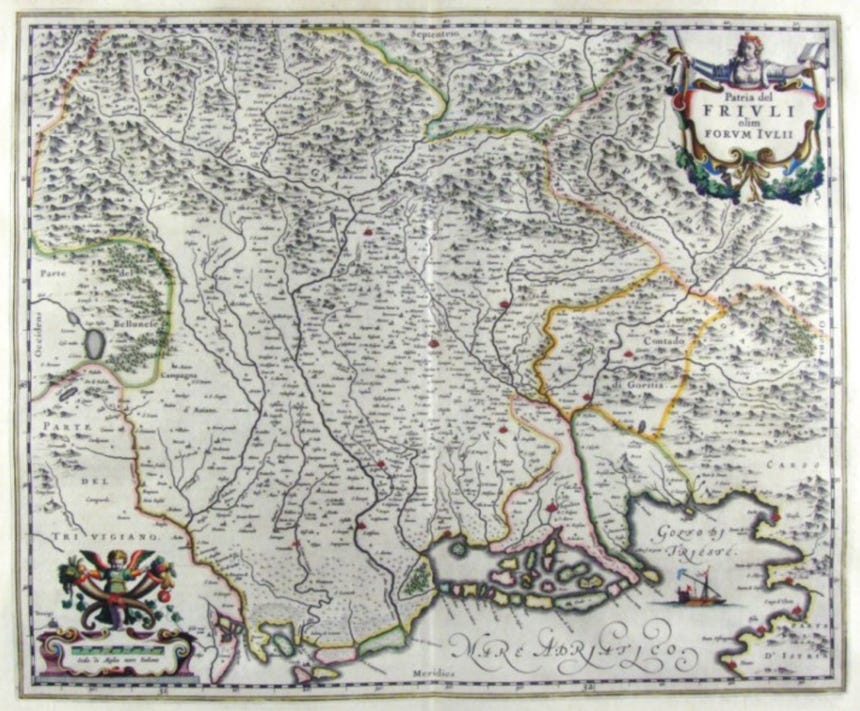
Although the name Friul emerged in the early medieval period from Forum Iulii, the territory already belonged in Roman times to the wider geographical framework of Venetia et Histria. What later became Friul was a region whose distinct historical profile gradually took shape between late antiquity and the Lombard age.
Origins
The ethnogenesis of Friul emerged from the interaction of several layers: pre-Roman populations, including Celtic-Carni and Venetic elements, followed by Romanisation and the spread of the Latin of the Aquileia area. Friulian developed out of this regional Latin base while preserving lexical and cultural traces of those earlier strata. The first of these layers dates back to the presence of Proto-Indo-European and semi-nomadic elements, which were subsequently absorbed by Palaeo-Venetian populations. The presence of these pre-Latin elements is also evidenced by the settlement of Hallstattian tribes in the region between the 5th and 4th centuries BC. The Carni people formed the first linguistic substrate of modern Friulian, a language with an extensive vocabulary of Celtic origin compared to Gallo-Italic languages.
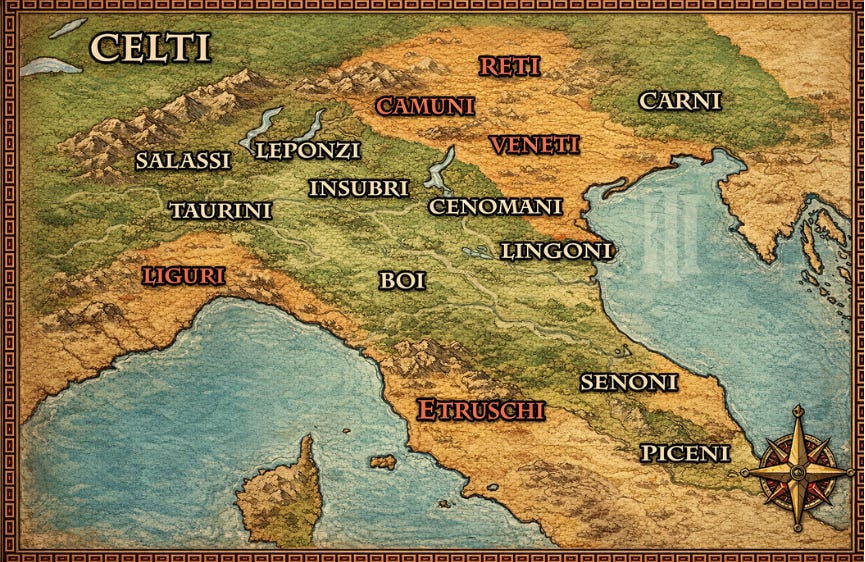
The linguistic traces of the Carni and Paleoveneti extend beyond mere logos to encompass the ethnos. Consider, for example, the presence in local folklore of a whole series of traditions and beliefs originating from the magical-religious sphere of the Celts. However, the linguistic aspect would only fully take shape at a later stage, with the Roman conquest and subsequent Latinisation. Aquileian Latin would indeed develop into the lingua franca of Regio X: the Carni-Venetian peoples adopted the Latin language, and probably adapted it with their own accents and inflections, whilst retaining many terms from their own language that were absent from Latin. Originally specific to the eastern part of Venetia and distinct from other neighbouring forms of Latin, the ‘Aquileian’ variant of Latin subsequently became established as the ‘rustic language’ of the common people, i.e. as a genuine vernacular.
The evolution of this rustic form of Latin, which was common in much of Venetia, into the new Friulian language – which distinguishes it from Venetian, Ladin, Istrian, Dalmatian, Solandro, Anuno and Romansh – took place around the 10th century AD. By this time, it had already established its fundamental characteristics, despite cyclical foreign invasions and the influence of Slavic and Germanic dialects. Consider, for example, the Lombard domination, which removed Friuli and its linguistic development from Latin influence during a period when Romance linguistic differences were emerging.
Even the adoption of Slavic, Tuscan, Venetian and Germanic loanwords did not alter the fundamental structure of the language up to that point. The clear separation between the ruling class, represented by the nobility and their foreign administrators, and the common people further increased Friulian’s isolation, giving it an increasingly unique character compared to the rest of the Romance language family. For example, Friulian vocabulary primarily consists of a medieval Latin substrate (the Aquileian variant), common to other Rhaeto-Romance languages. Subsequently, Celtic remnants, Germanic loanwords, Slavic contributions and Greek or Arabic influences were added to this. Furthermore, many words entered Friulian via Tuscan and Venetian. A recent classification proposal from the field of linguistics suggests replacing Ascoli’s definition of “Rhaeto-Romance” by classifying Venetian, Istrian, Dalmatian, Ladin, Romansh, Anuno and Solandro under the heading of “Carnic languages” or “Italo-Dalmatian languages”.
Therefore, Friul can be seen as a contact zone where the Latin, Germanic, and Slavic worlds meet, and the lexicon does contain Germanic and Slavic elements, shifting eastwards towards the ‘barbaric, mysterious yet powerful’ civilisations of the Slavic and Germanic peoples. Friuli’s historical development was shaped for long periods by contact with Germanic political and cultural worlds, especially during the Lombard age and in later imperial contexts. These contacts left clear marks on the region’s vocabulary, institutions and cultural memory.
A Possible Classification
From a linguistic point of view, Friulian is a Romance language with a clearly autonomous profile. It continues the Latin of the Aquileia-Friuli area, while also preserving pre-Roman substrate features and later Germanic and Slavic influences. In linguistic scholarship it has often been discussed alongside Ladin and Romansh within the wider Rhaeto-Romance or Ladin question, though its degree of autonomy and the exact boundaries of that grouping have long been debated. What matters here is that Friulian is neither a mere variety of Venetian nor a peripheral form of standard Italian, but a historical language with its own development. Precisely for these reasons, the Friulian language is situated halfway between the macro-group of Italo-Romance languages (which includes Italian and its dialects) and that of the “Celtic-Romance” languages (such as French, Franco-Provençal, Occitan and Catalan). In a sense, given a certain similarity with some Lombard Alpine dialects, the Carnic group can be compared to the Gallo-Italic group (comprising Piedmontese, Lombard, Emilian and Romagnolo), which is itself a linguistic group situated midway between the Italic and the Celtic-Romance groups. The linguistic theory that the Carnic dialects are closely related due to their numerous shared phonetic features gained traction in the early 19th century.
The latest hypotheses suggest that Friulian possesses a distinct linguistic independence, developed primarily through linguistic isolation and the strict preservation of its own identity, which is as autonomous from Venetian as it is from the mountain dialects of Graubünden and the Dolomites. Nevertheless, the ‘Pan-Ladin’ theory enjoyed considerable success until the 1920s, even taking on explicitly political dimensions. An example of this is the Tesaur de lenghe furlane, a text written by the linguist Achille Tellini which outlines a project for national renewal based on the creation of a Ladin state stretching from Graubünden through Veneto to Friuli.
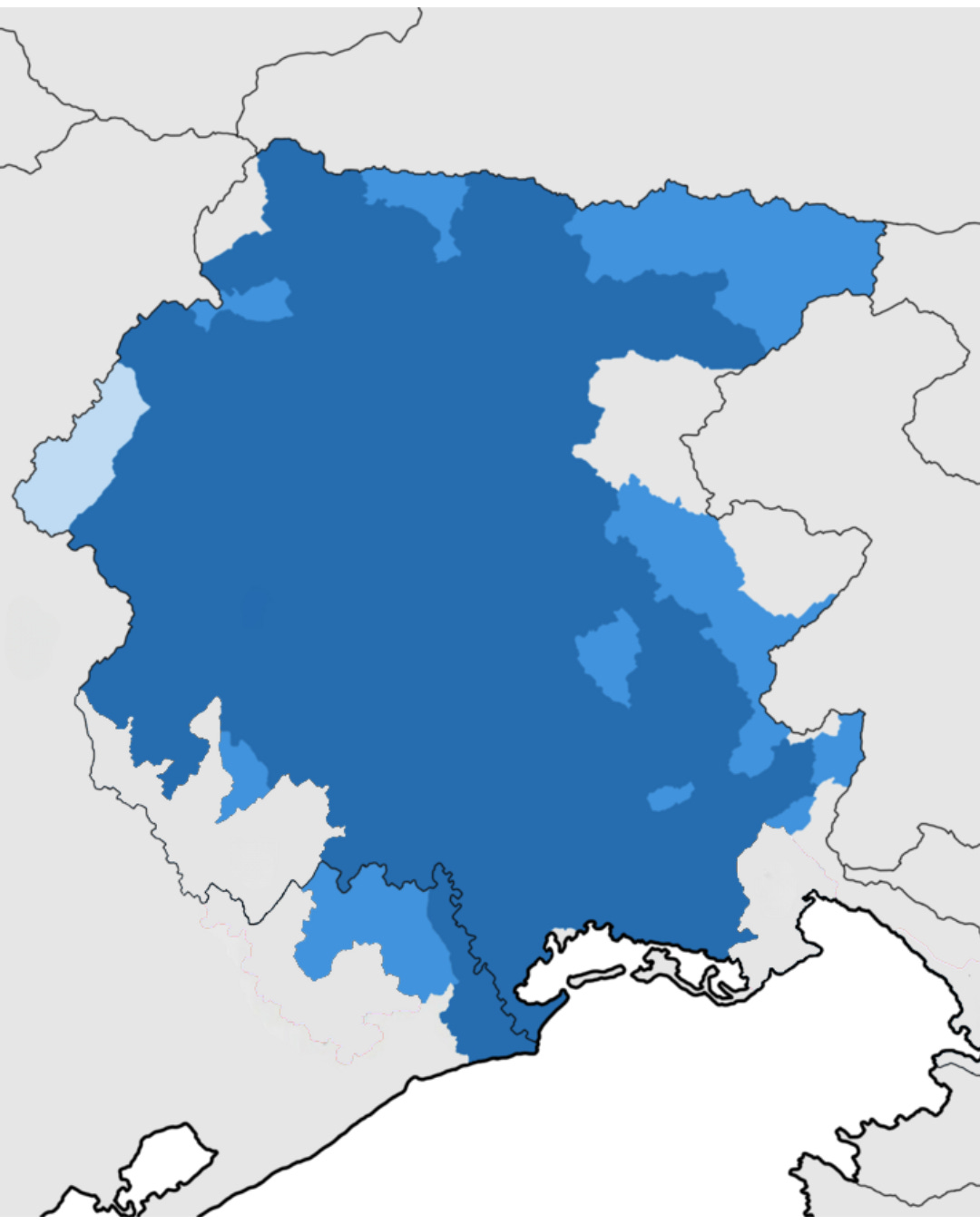
Friulian was originally spoken from Cadore to the Trieste area. The latter has now been heavily influenced by the Venetian language. In Trieste in particular, Tergestino — a Romance language highly similar to Friulian — was in use until the 16th century, after which it gradually became the language of the local nobility until the 19th century. This dialect was also closely related to Muglisano and Carniolino, which were more commonly spoken by the working classes and were equally similar to western Friulian dialects. Following the Second World War, Tergestino, Muglisano and Carniolino became extinct, being replaced by Triestine and Muggese (both derived from Venetian) in the Karst–Trieste area and by Slovenian in Carniola. These two cases already demonstrate that Friulian is by no means homogeneous across the region. In fact, significant variations can be found, generally associated with four main linguistic areas: Central Friulian (the best-known standard form); Eastern Friulian (more accurately, Gorizia Friulian, bordering the Bisiac dialect); Carnic Friulian (the most conservative form); and Western Friulian (influenced by Venetian).
Of the many Romance languages, Friulian is one of the most vibrant, with relatively consistent phonetic and morphological features. It has also been used as a vehicle for literary expression, yielding works of considerable poetic skill and cultural significance. Unlike other languages spoken within the territory of the Italian Republic, Friulian has retained a distinctively archaic and traditional character, resisting external influences effectively. Evidence of the vitality and ‘purity’ of Friulian can be seen in its firm presence across the region, particularly in mountainous and rural areas. However, the most distinctive local characteristics have given way to a moderate degree of linguistic standardisation. Nevertheless, certain areas, notably the Karst-Trieste region, have experienced the gradual loss of Friulian.
Neither Ladin nor Venetian
In his 2001 atlas, Koryakov neither presents Friulian as merely a variety of Venetian nor as part of a genuine ‘Rhaeto-Romance’ linguistic unit in the strict sense. In fact, he states that ‘Rhaeto-Romance’ is merely a socio-cultural concept encompassing three languages: Rumantsch, Ladin and Friulian. He then adds that further east, there are varieties ‘distinct enough to be treated as separate external languages’: Ladin, Venet, Friulian and Istriot. This is arguably the most significant aspect of his classification framework.
Therefore, Friulian is a distinct Romance language. It is close to the Ladin-Romansh cluster in terms of distribution and typology. However, it has not been absorbed into a strong genetic Rhaeto-Romance unit. Indeed, cartographically, it is treated as a separate language, alongside Ladin and Venetian.
Some figures on the current situation
The idea that Friulian is a fossilised language in terminal decline is not just an example of intellectual laziness; it is also a statistical error. Data from a survey conducted across 178 municipalities in Friuli-Venezia Giulia and eastern Veneto reveal a critical mass that many European minorities would envy:
There are 444,000 active speakers. More than half of the residents of the Friulian-speaking area use the language regularly or occasionally.
700,000 are ‘involved’. If we include those who understand the language even if they do not speak it, an extraordinary figure emerges: Nine out of ten people.
The hidden reserve: One in four people say they could ‘reactivate’ their language skills with the right encouragement.
It is commonly believed that Friulian is confined to the valleys of Carnia and rural villages. However, the facts tell a different story: the cities have become centres of resilience and unexpected vitality. While Udine confirms its central role, it is the data from Gorizia and Pordenone that represent the real ‘positive surprises’ of the report.
In Udine, 40% of people speak the language, while 82% understand it.
Gorizia: a solid 23% of active speakers, and 73% who understand it.
Pordenone: Despite neighbouring influences, 18% of people speak Friulian, and 55% understand it.
These figures suggest that Friulian has passed the test of urbanisation, transforming itself from a ‘hearthside’ language into a cross-cutting element of modern urban identity.
In addition to this, one of the most harmful myths is that protecting minorities is an unacceptable burden on taxpayers. However, the figures completely refute this narrative: 77% of citizens are in favour of using public funds for the Marilenghe project.
This is not just a matter of general support, but also a specific economic mandate. Citizens consider an investment of an average of 22 euros per capita to be appropriate. To put this figure into political perspective, it is four times higher than the current level of investment. Therefore, there is a ‘popular’ financial willingness that just needs to be translated into serious, shared projects. However, this seems to be coming up against the wall of bureaucratic efficiency today.
Friulian is also undergoing an interesting transformation, shedding its solemn guise in favour of relational immediacy. The data speaks for itself: One in four people use Friulian in voice messages. However, a fundamental socio-cultural nuance emerges from the digital data: online, the language is heard far more than it is read or written. We are faced with a culture that remains deeply oral despite its digitalisation. Friulian has become the language of affection and spontaneity — a ‘symbolic and identity-defining language’ that smartphones have made portable and integral to everyday life.
The underlying problem is the inefficient regional policy
While civil society is ready to invest and contribute, the institutions seem to have opted for haste and secrecy. The 2026–2030 Plan was approved within a timeframe that ‘Il Passo Giusto’ describes as a ‘political and administrative record’, but this came at the expense of participatory democracy.
The stages of this solitary race are emblematic: the Technical-Scientific Committee approved the plan on 16 December, the ARLEF Board of Directors followed suit on 23 December, the text reached the Department on 7 January, and the Regional Executive gave preliminary approval on 23 January. In just three months, a document that will determine the future of the language for the next five years has been finalised without the involvement of associations, local councils or the education sector.
In this case, efficiency takes the form of a ‘bureaucratic bunker’ where quality control is absent and dialogue is perceived as an obstacle.
Imagine a teenager in Udine who, between watching one video and the next on WhatsApp, taps the microphone icon to quickly and instinctively send a voice message in Friulian. At that very moment, just a few kilometres away, a bureaucrat inside a hushed regional office signs a five-year language policy plan that the teenager will never hear about. It is 2026, and the future of Marilenghe (Mother Tongue) is playing out right here, in a silent collision between a grassroots digital renaissance and institutional procedures that seem to be becoming increasingly self-referential.
Friulian in 2026 has overcome the risk of biological extinction, but now faces that of political irrelevance. While nearly 70% of respondents favour a greater presence of Friulian in schools, and young people are using it to send voice messages, there is an administrative drift that refuses to listen to civil society.
Fifty years on from the 1976 earthquake — an event that marked a rebirth of identity based on participation — the risk is that we will betray that spirit. Historically, the people of Friuli have been described as ‘brave, honest and hard-working’, but the current management of language policies seems to be banking on another stereotype: that of the ‘sotàns’, submissive citizens who passively accept decisions imposed from above in exchange for some last-minute handout.
Will the roughly 700,000 people who speak or understand the language today remain silent observers of its institutional hollowing-out, or will they assert their right to play an active role in shaping their future identity? Marilenghe does not need closed-off offices, but rather open spaces, both physical and digital.
Sources
https://web.archive.org/web/20190401154429/http://www.provincia.udine.it/il-friuli/lingua-1
Lexikon der Romanistischen Linguistik, Max Niemeyer Verlag
Kurm : ipotesi e riscontri sulla presenza dei Celti e di altre popolazioni preromane nella Bassa friulana, Associazione culturale “La Bassa”
Aquileia – Defensores urbis, Valerio Massimo Manfredi
La patrie ladine, Donato Toffoli
Tesaur de lenghe furlane, Achille Tellini
La Venezia Giulia: una questione friulana, in Venezia Giulia. La regione inventata, Roberta Micheli
Atti del 41º congresso della Società Filologica Friulana
Reliquie ladine raccolte in Muggia d’Istria, Jacopo Cavalli
Studi Linguistici Friulani, Mario Doria
Historiae Longobardorum - Paolo Diacono
https://ilpassogiusto.eu/al-friulano-non-far-sapere/
Comunicato Stampa Arlef sull’utilizzo della lingua friulana, “Lingua friulana: la parlano attivamente 444.000 persone”, Udine, 16 maggio 2024
Koryakov, Atlas of Romance languages, 2001
Have you read on this paper about the longest venetic inscription? You should do a post about It
https://www.scirp.org/journal/paperinformation?paperid=113592