The Risorgimento Myth: debunking common misconceptions about Italian unification
Why Italy doesn't exist as a nation; How Britain and the Freemasonry controlled the process; The new state's jacobin, revolutionary legacy; Italian national identity as anti-national by design
Risorgimento, which can be translated as “Resurgence”, is a topic that is difficult to analyze from a neutral perspective, both because of the partisanship it tends to invoke, starting form its name, but primarily because much of its contemporary accounts and subsequent historiography have been influenced by pro-unification rhetoric which, in turn, has influenced its perception in popular culture as well - so much so that many inaccurate assumptions have been taken as fact by the uninformed.
For this reason, this article will consist mainly of a series of clarifications of the common myths surrounding Risorgimento, among different themes and time periods. As such, it won’t be a strictly chronological narration, but diachronic in how it examines historical events.
We begin by explaining that Risorgimento was not a univocal movement, that there existed very different views on what Italy even was, and what it even meant to “be Italian”. We then explore the national-liberal and anti-clerical roots of Risorgimento, and identify its main external contributors as the British liberal establishment and the Freemasonry.
Finally, we argue that the way in which Risorgimento was achieved and how the new state was structured post-unification have led to the extension of a centralized model of governance through military repression and cultural assimilation, with the direct effect of making Italian national identity inherently anti-national and predicated on the negation and appropriation of pre-existing regional ethnic identities, traditions and histories.
The institutional and administrative dysfunctions that have characterized the Italian state ever since its founding, we conclude, are a direct consequence of its failure to harmonize the various regional ethnic prerogatives through an appropriate governance model. Instead, such ethnic interests have continuously clashed with each other, treating the state as an arena of competition rather than a shared national commonwealth.
The heterogeneity and multiplicity of “Italian” unification movements
Any serious analysis of Italian Risorgimento must begin with a clarification: what did the word Italy actually mean in the mid-19th century?
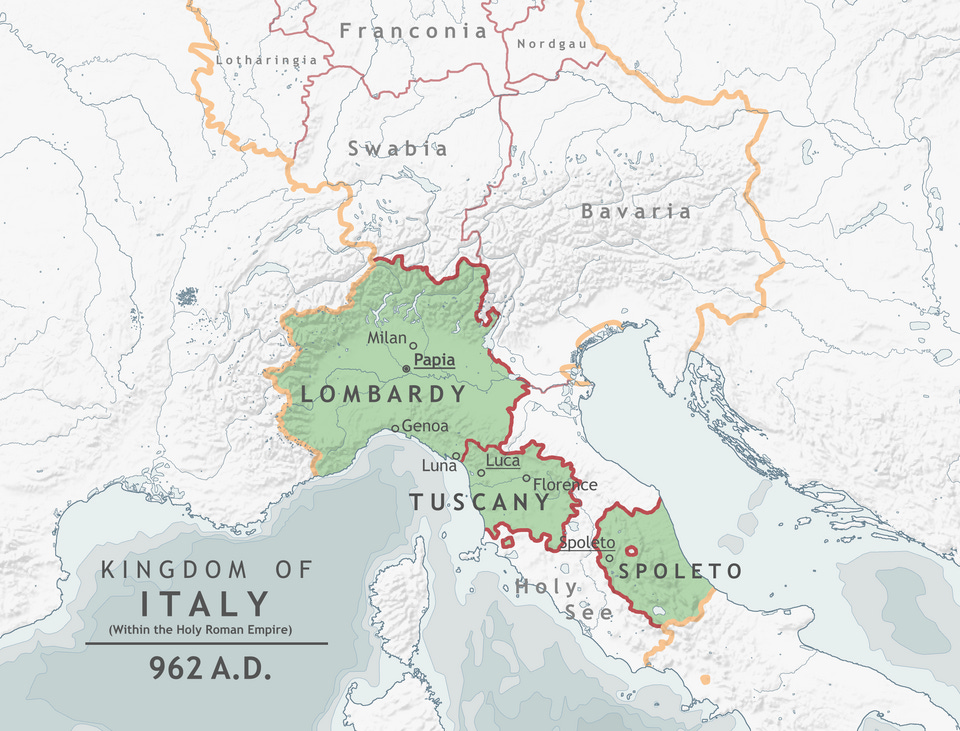
The term did not yet refer to the political entity that would emerge after 1861. Instead, it often denoted a historically defined territory with relatively stable boundaries, corresponding broadly to the medieval Kingdom of Italy within the Holy Roman Empire. This political and geographical entity, known as the Regnum Italicum, existed from the early Middle Ages and retained recognizable territorial contours from roughly the 9th century until the 19th.
In practical terms, this “Italy” largely coincided with the territories that today correspond to the administrative regions of Piedmont, Lombardy, Emilia-Romagna, Liguria, and Tuscany. With the partial exception of Tuscany, these lands formed a relatively coherent cultural and linguistic area often described as Gallo-Italic. Consequently, the earliest phases of the independence movement were largely rooted in the political and social dynamics of this northern macro-region rather than in a fully pan-peninsular national project.
To provide a clearer geographical context, in the following article we will refer to Northern, Central, and Southern Italy using the modern definitions of these terms.
The Napoleonic period played a crucial role in shaping this outlook by providing Northern Italy with its first modern experience of political unification in centuries. Under the Kingdom of Italy (1805–1814), Napoleon brought much of the Gallo-Italic world within a single framework, introducing common legal codes, a hierarchical bureaucracy centered on prefects, fiscal centralization, and mass conscription. Although the experiment was short-lived and ended with the Restoration, it fostered among Northern elites and parts of the population the perception that the Gallo-Italic territories could form a viable nation-state, leaving behind a lasting political memory that served as an important conceptual reference during the early Risorgimento.1
Evidence that this more limited understanding of “Italy” persisted during the first two Guerre d’Indipendenza (Wars of Independence) can be found in sources originating from figures who otherwise strongly disagreed with one another. The policy of Napoleon III, for example, reflected a vision of Italian unification confined largely to the Northern territories historically associated with the medieval Kingdom of Italy. The French emperor strongly opposed the annexation of the Papal States and imagined instead a Savoyard kingdom operating within the French sphere of influence.
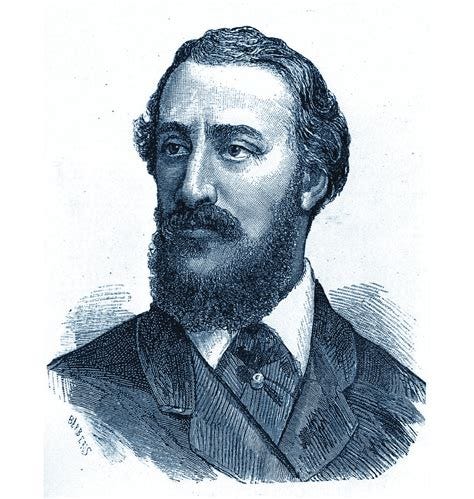
Similar limits appear in the writings of leading Italian thinkers. Carlo Cattaneo, one of the most prominent republican intellectuals of the period, held a distinctly Northern perspective and focused primarily on the political development of the Cisalpine region and its liberation from Habsburg influence.
Carlo Cattaneo (Milan, 1801 – Lugano, 1869)
In Central Italy, others did not want a united Italian state to extend South of the Volturno river (thus excluding Southern Italy), and regarded the papacy as the main obstacle. In the South, some imagined a far wider political space, even extending to Malta, with the Bourbon monarchy as the primary enemy.
At the same time, broader visions of Italy that included the entire peninsula did exist, though they were far from dominant and often emerged in specific ideological environments.
One such conception was promoted by Catholic intellectual circles associated with Vincenzo Gioberti and Antonio Rosmini. This current, historically labeled the Neo-Guelph faction, proposed a confederation of Italian states under the leadership of the Papacy, rather than a unitary nation-state. While influential in certain intellectual and ecclesiastical milieus, the project struggled to gain significant popular support.
Vincenzo Gioberti (Turin, 1801 – Paris, 1852)
A different model was advanced by thinkers such as Carlo Pisacane. Rather than beginning with northern unification, this approach envisioned a revolutionary transformation originating in the Kingdom of the Two Sicilies. The idea was that a social revolution in the largest state of the peninsula could seize power there and then extend northward, eventually using the industrial and economic resources of Northern Italy to stimulate development across the entire peninsula.
Although Pisacane’s own attempts ended in failure, the broader revolutionary narrative proved attractive in southern political culture and contributed to the climate that made Garibaldi’s Expedition of the Thousand possible.
Carlo Pisacane (Naples, 1818 – Sanza, 1857)
In the Northeastern regions - particularly in Venetia - Risorgimento sympathies also appeared, but their character differed from those in the North-West or the South. Support for Italian unification was largely confined to segments of the Venetian-Dalmatian elite and was often driven by pragmatic concerns, including fears of demographic and administrative policies pursued under Emperor Franz Joseph of Austria. These sentiments rarely translated into mass mobilization, and were frequently elite-led and instrumental (linked to status or geopolitical calculation). As a result, pro-Savoyard uprisings in the northeastern territories generally failed to gain widespread popular backing and often ended in political failure.
Taken together, the ideological landscape of the Risorgimento during the first two Wars of Independence was far more fragmented than later nationalist narratives suggest. Several competing visions of Italy coexisted:
A Neo-Ghibelline conception, supported in practice by Napoleon III and influential in the Northwest and Tuscany, which focused on the territories corresponding to the medieval Kingdom of Italy.
A Neo-Guelph project, promoted by Catholic intellectuals, envisioning a confederation of states under papal leadership.
A social-revolutionary model, associated with figures like Pisacane and popular in parts of the south, proposing that revolutionary transformation in the Kingdom of the Two Sicilies would eventually unify the peninsula.
And a northeastern Risorgimento current, largely confined to regional elites and unable to mobilize broad popular support.
Rather than representing a single coherent national movement, Risorgimento comprised different geopolitical visions, ideological programs, contingent and opportunistic motives, and regional interests that one could even describe as ethnic.
These divergences would be retrospectively harmonized by later Italian historiography: figures and currents that were bitterly antagonistic - like Mazzini and Cavour - would be placed side by side as if they were complementary architects of the same project, ignoring the real conflict between their incompatible political projects.
The plurality of Risorgimento projects coincided with a plurality of ways in which the various peoples of the peninsula used the terms “Italy” and “Italian”.
The plural meaning of the terms Italy and Italian
Thus, if we are to talk about Italy and Italians at all, we must refer to many “Italys” and many ways of being “Italian”, but it was certainly not a single identity for every inhabitant of the territories that would come to be incorporated in the future Italian state. There was no one way to be Italian, and often these identities were mutually exclusive - e.g., the “Italian” identity in the Northern regions excluded by definition the entire Center-South, and viceversa.
Being “Italian” was not a univocal, monolithic and objective identity. It meant different things in different regions, for different peoples and social classes, and even in different qualitative scopes. In some cases, identifying as Italian was indeed an expression of an organic ethnic identity that merited self-determination; in others, it was simply a label of convenience for the local elite class that was adopted for its own interests.
In the Northwest and in Tuscany, identifying as Italian was relatively common and culturally intelligible. These regions had long been associated with the historical concept of Italy, having been part of the medieval Regnum Italicum since the Middle Ages. For roughly a millennium, inhabitants of these territories had been described in various political and literary contexts as “Italian”, and shared certain a sense of nationhood that could (and would) inspire popular support as a national label during the Savoyard wars of expansion.
In parts of the Centre (specifically the Papal States), the label “Italian” was understood as essentially meaning loyalty to the Pope rather than to a secular national state (we will come back to the interpretation of Italian identity as non-national later in the article).
In the South, the use of the term was far more situational and could be adopted tactically. Local political and social identities were typically anchored either to the institutions of the Kingdom of the Two Sicilies and in regional or dynastic loyalties, or depended on elite ideological networks and external encouragement. Intellectuals and political activists could employ the language of Italian nationhood, but the concept did not correspond to a deeply rooted identity among the broader population, and this could lead to extreme volatility of loyalties once events accelerated.
The situation was different again in the Northeast, in Venetia and in the adjacent territories of the Habsburg Empire. There, identifying as Italian was not a widespread habit among the population, and it could easily overlap with Venetian identity, or more loosely refer to anyone that was not German nor Slavic. Political loyalties and cultural identities were shaped by other historical frameworks, including the legacy of the Venetian Republic and the administrative structures of the Austrian Empire.
Italian identity did not exist in a cohesive form: it was not equally organic and pervasive across the teritories that would come to form the Italian state. Its depth, social reach, and meaning varied by region and by class. In some areas, “Italian” identity seems to have been largely confined to politically active liberal or Masonic-oriented elites; in others, it extended more broadly, though with different meanings depending on the social stratum adopting it.
The Savoyard political elite understood this, and that if the new state was to function effectively, such an identity would have to be constructed. However, in the decades immediately following unification there were few practical instruments capable of achieving this objective on a mass scale.
More systematic tools only appeared later. During the Fascist period, the regime implemented aggressive policies aimed at standardizing language and culture across the peninsula. The promotion of standard Italian through education, administration, and media proved relatively successful in establishing linguistic uniformity. Attempts to reshape the cultural orientation of the peninsula along a more homogenized model, however, met with far more limited success.
The result is that, even today, Italy remains characterized by significant regional diversity in culture, historical memory, and social identity. While the Italian language has become widely shared, the idea of a fully monolithic Italian identity has never entirely replaced the strong regional traditions that long predate the modern state.
Italian identity as non-national
The debate around the “legitimacy” of Risorgimento as a whole is polarized around the question of whether “Italy” even existed, or was worthy of becoming a nation-state. On one side, critics deny it - citing the high ethno-linguistic diversity and divergent historical experience of the various regions of Italy - while supporters cite (and appropriate) the legacy of Rome and the Renaissance to support their thesis.
Both sides err in conflating the existence of Italy as a historical-civilizational reality with the existence of Italians as a single nation in the modern sense.
British historian David Gilmour notes that:
“Until the end of the eighteenth century Italy remained a literary idea, an abstract concept, an imaginary homeland or simply a sentimental urge”.2
“Italy” certainly existed before unification, but mainly as a geographic, cultural, and imperial idea: the land of Rome, of Latin Christianity, of great cities and regional traditions. That is not the same as a nation-state.
“Rome” represented a universal and imperial principle capable of incorporating different peoples in a universal order, not an identity on which to legitimize a nation-building project. Invoking Rome can give (and has given) Italian unity prestige and a certain superficial depth, but this doesn’t mean that Italy as a whole formed one coherent nation prior to unification.
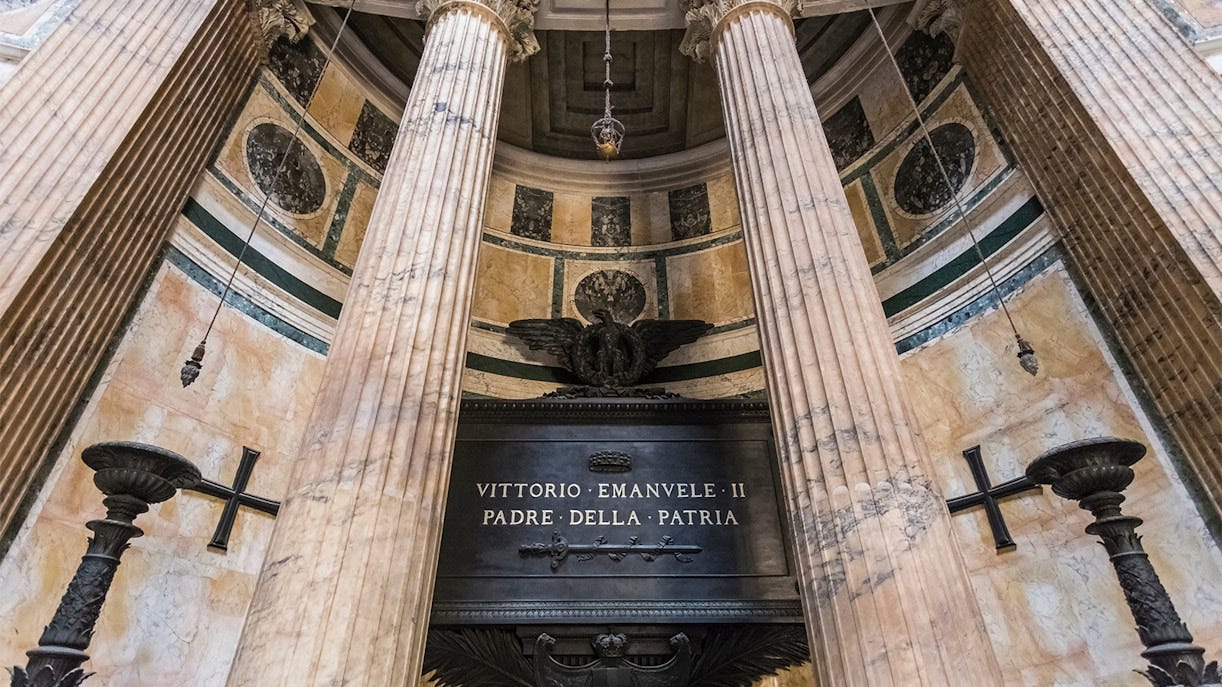
The House of Savoy also fully embraced this rhetoric. Indeed, it became standard for Italian monarchs to be buried in the Pantheon, a church which once housed altars dedicated to all the deities of the Roman tradition, as well as the tomb of Raphael, the painter who symbolised the Renaissance.
Supporter of Italian unification have made (and continue to make) a category mistake: treating a broad, layered, plural civilization as if it were already a unified national community. But pre-unitary Italy was inhabited by strongly distinct peoples and regional identities - Venetian, Neapolitan, Sicilian, Piedmontese, Tuscan, and others.
The existence of an Italian cultural or imperial identity did not erase that plurality, nor could it function as the foundation of a centralized nation-state.
Risorgimento as an anti-religious movement
Risorgimento’s national rhetoric - at least the one of the current that prevailed - was inextricable from its liberal and revolutionary character, and can be understood as the adoption and expansion of a precedent that was first put in practice during the French Revolution.
The French revolutionary precedent helped normalize across Europe, especially in the period 1820–1831, a new way of imagining collective belonging: the nation as a moral subject endowed with a unified will, expressed through narratives, symbols, and codified legal-political forms. Nationalism can bee seen as an interpretive toolkit developed and circulated by educated elites, and adaptable to different local contexts.
In the case of Italy, “the Nation” could function at once as a mobilizing category, capable of recruiting populations with limited stake in the institutional outcome and, once a new state had been established, as a legitimating screen for repression in the name of “unity” when groups or regions failed to align with the new order.3
As mentioned in the previous section, the Jacobin-Napoleonic experience was a foundational precedent for the Savoyard ruling strata, not because they were doctrinaire republicans (they were actually exiled to Sardinia when the French occupied Piedmont), but because the first workable blueprint for territorial reordering in Northern Italy had been the Napoleonic/Jacobin administrative model. It supplied the administrative imagination for state-building, the expectation of centralization, and the notion that national identity could be engineered from above.
A similar argument is shared by one of Risorgimento’s own contributors and contemporary chroniclers, Jessie White Mario. According to her, the Napoleonic Kingdom of Italy represented the first modern political framework in which “Italy” re-emerged not merely as a cultural or geographical expression, but as a concrete state form. In her reading, the Napoleonic restoration of the title “Kingdom of Italy”, together with its symbols, institutions, and elite loyalties, helped make Italian unity imaginable in practical terms, as it supplied an early precedent that later patriots could radicalize and complete in 1861. In her view, the Kingdom that would be proclaimed in 1861 was the maturation of a political template first sketched under Napoleon.
Another similarity between French revolutionaries and Italian Nationalists was their aversion to the Catholic Church, which manifested in a cultural and ideological conflict between national-liberal forces and Catholic tradition. Drawing on Enlightenment and Jacobin legacies, the Church as an institution was increasingly portrayed as backward and incompatible with modern nationhood - an anti-clerical framing that helped structure the movement and legitimize decisive political acts as forms of liberation from a “foreign” power.
This conflict was sustained by a wider ideological and organizational environment in which liberal-national circles, often linked to clandestine networks such as the aforementioned Carbonari and Masonic lodges, fused the national cause with a secularizing agenda. Thus, anti-clericalism can be said to be one of the constitutive forces of the Risorgimento, informing its revolutionary self-understanding. The reduction of ecclesiastical power was widely considered as a necessary condition for Italy’s political modernization, but the polarization generated by this process did not end with unification, and continued to influence Italian public life for decades.4
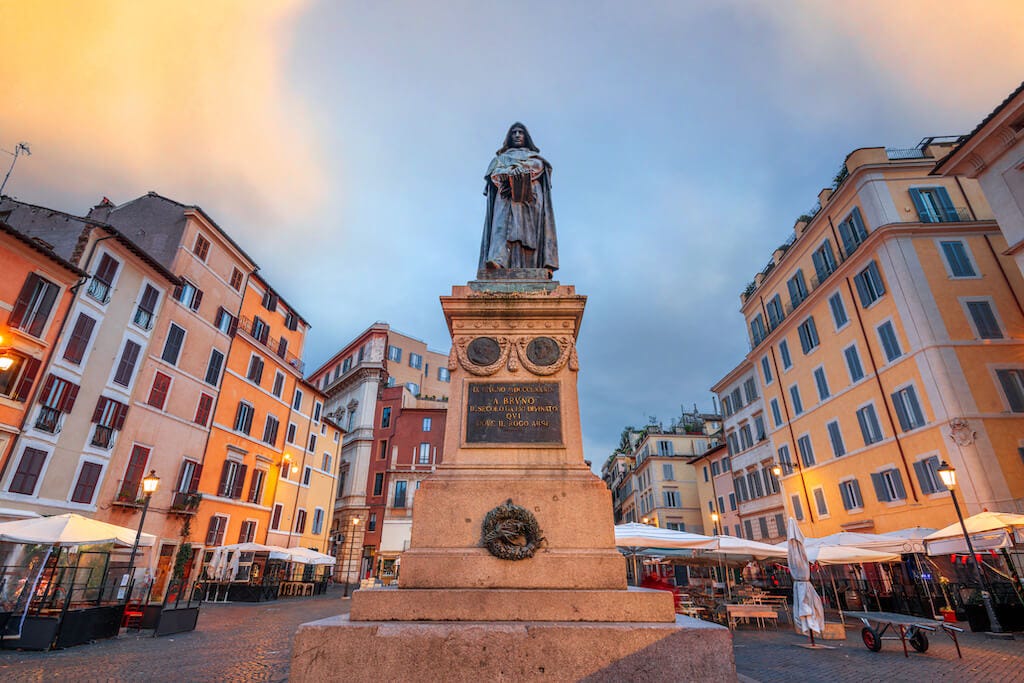
A monument dedicated to the philosopher Giordano Bruno in Rome, erected in 1889 at the instigation of the Roman Liberal-Radicals.
Once a Dominican friar, Bruno renounced his vows to pursue philosophical inquiry, which led him to reject the dogmas of Catholicism as he traveled throughout Europe. He was eventually arrested, tried by the Inquisition, and condemned to be burned at the stake on February 17, 1600, at the very spot where the monument dedicated to him stands today.
The statue faces the Vatican, and according to some interpretations, its pose and expression convey Bruno’s disappointment at seeing that the papal seat is still standing. It was built by the Freemason Antonio Ferrari; it seems that the idea for the location came from the theorist of the Paris Commune, Armand Levy.
At the start of the Risorgimento era, there were hopes of reconciling Italian nationalism with the Church. In 1846, the election of Pope Pius IX initially thrilled Italian liberals - Pius IX showed liberal leanings, granted amnesty to political prisoners, and there was a brief flirtation with the idea of the “Neo-Guelph” solution we mentioned earlier (whereby the Pope might lead a confederation of Italian states).
The liberals’ hope quickly faded when, in 1848, Pius IX refused to support a war against Catholic Austria, opposed to pitting Catholic against Catholic. For this he soon became a target of radicals after he fled Rome in 1848 (when Mazzini and others proclaimed an ephemeral “Roman Republic”). Pius’s experience in 1848 transformed him into a determined opponent of liberal nationalism, and from then on the Papacy and staunch Catholics saw the Risorgimento leaders as dangerous revolutionaries – anti-Catholic, conspiratorial, and illegitimate.
The Pope’s fears were not unfounded: the more secular and pro-unification elites increasingly saw the Church as an obstacle to unity and progress, and the Kingdom of Sardinia-Piedmont had already begun stripping the Church of privileges in the 1850s under Cavour’s government - the Siccardi Laws of 1850 curbed ecclesiastical courts and immunities; in 1855 monastic orders were suppressed and Church lands confiscated in Piedmont.
As the new Kingdom of Italy took form, these anticlerical policies were extended as well: monasteries were closed, bishops jailed or exiled for resisting state control, and the once-dominant Catholic culture was pushed to the margins of public life. In 1866–67, the Italian parliament passed laws dissolving most religious orders and expropriating their property (often auctioned off to bourgeois landowners), alienating devout villagers who relied on local monks and nuns for charity.
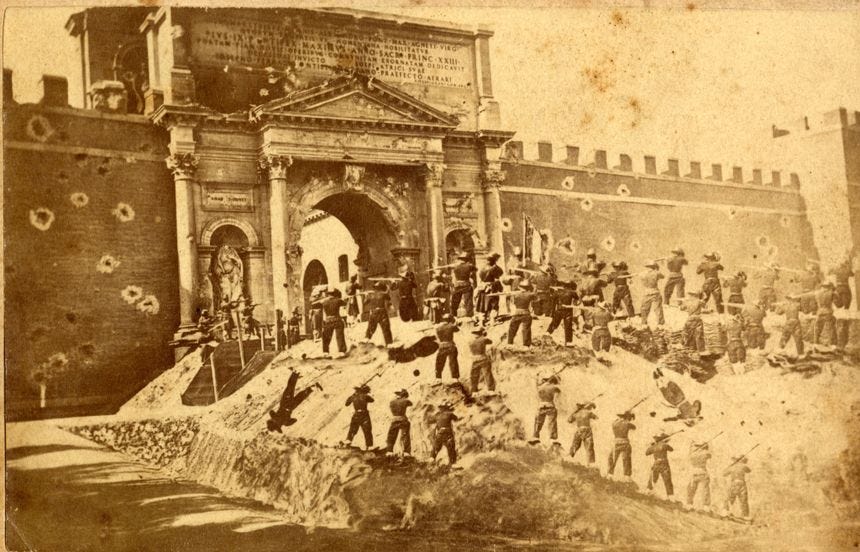
The climax of this struggle came with the seizure of Rome. Throughout the 1860s, Pius IX adamantly refused to surrender his temporal rule over Rome and Central Italy (the Papal States), even excommunicating key unification leaders. In 1860, after Piedmont annexed most of the Papal States, Pius IX issued an encyclical condemning the theft of Church lands and excommunicating all who participated - effectively casting out the King of Italy and his ministers. In 1870, taking advantage of Napoleon III’s defeat in the Franco-Prussian War (and thus the removal of the French garrison protecting Rome), Italian troops breached Rome’s walls and took the city. The Pope withdrew into the Vatican, declaring himself “Prisoner of the Vatican” and refusing to recognize the Italian state. The spiritual head of Italy’s overwhelmingly Catholic population had effectively declared non co-operation with the new kingdom, which he saw as founded on sacrilege and usurpation.
A contemporary photomontage of the breach at Porta Pia, 1870
In 1871, Pius IX forbade Catholics from voting or running for office in Italy (Non Expedit decree), freezing out devout Catholics from political life for decades. Italy responded with the Law of Guarantees, trying to mollify the Pope with honors and a stipend, but he rejected it. The standoff between the Vatican and Italian state would not be resolved until 1929 with the Lateran Treaty. In the meantime, Italy endured a kind of internal cold war at home: most of its citizens were loyal Catholics but their chosen spiritual leader regarded the Italian state as illegitimate.
For everyday Italians in the 1860s-1880s, this translated into a mutually exclusive division of loyalties. One could either stand with the Patria (fatherland) or with the Pope. The secular Italian authorities did fear that clergymen were fomenting opposition to the state, and indeed many clergymen in the South and in Venetia did bless or shelter insurgents as “defenders of the faith” against the “Piedmontese infidels”. Angela Pellicciari’s thesis that Risorgimento was essentially a disguised religious civil war has some merit, because the new Italian state engaged in what can be seen as a “persecution of religion” in the name of nation-building.
Strong words, but consider the lived experience of a “liberated” peasant in the 1860s: suddenly the village priest is forced to stop ringing church bells at certain hours (a real regulation imposed by secular authorities), the monastery that provided soup to the poor is dissolved, taxes increase, and young men are conscripted into an army that the Pope has denounced. It indeed felt to many like an assault on their way of life and belief, orchestrated by anti-religious forces.5
The ideological battle split even the intellectual class. Some liberal Catholics (the so-called “Catholic liberals”) tried to reconcile Church and nation, urging the Pope to accept a unified Italy and urging Italy to grant the Church freedom. But Pius IX’s intransigence and the Italian government’s anticlerical fervor made compromise elusive. On the other side were the “Catholic intransigents”, especially strong in places like Venetia and parts of Lombardy, who opposed the new state outright. In Venetia, Catholic conservatives formed a backbone of anti-unification sentiment. Padua was even called “a capital of intransigence”.
Venetian historian Riccardo Pasqualin documents how, after unification, Paduan reactionaries and devout Catholics published satirical papers like Il Codino (a derogatory term for reactionaries) mocking the new liberal order. These Catholic circles were harassed by authorities - their newspapers fined and shut down, their meetings surveilled, some priests and laymen even beaten by patriotic thugs in the street. Violence against perceived “clerical” (pro-Church) elements was not uncommon, and the state often turned a blind eye. Pasqualin recounts that in Austrian-ruled Venetia before 1866, tensions were rising: liberal-nationalist students would attack Catholic conservatives, burning papal documents in bonfires at the University of Padua while the Austrian police quietly looked the other way (perhaps hoping to discredit the liberals). After Italy took over, those same nationalist youths had free rein to marginalize the Church’s supporters.6
Italy’s unification can thus also be seen as a culture war: secular modernizers versus defenders of Catholic tradition. In the countryside and in certain regions (Venetia and Southern Italy), many common folk sided with the latter. The Southern “brigand” war was arguably infused with religious rhetoric (rebels carrying images of the Madonna and shouting “Viva Maria!”), as well as with monarchist nostalgia - but the Italian state was set on its “secularizing” mission behind the pretext of national “unity” and “freedom”.
It is telling that Italy is unique among Western European countries in having such a late and protracted Church-State conflict at its founding. In France, the revolution had come much earlier; in Germany, Bismarck would wage a Kulturkampf in the 1870s but to a lesser extent. In Italy, the identification of nationalists with anti-clericalism was strong. Even Garibaldi at one point fantasized about kidnapping the Pope or making Rome a secular capital (famously calling Pius IX “a wolf” to be thrown out of Rome). Freemasonry thrived in the post-1860 decades as a quasi-official ideology among Italy’s ruling class, further alienating the devout.
Only in the late 19th century did more pragmatic leaders like Agostino Depretis and especially Giovanni Giolitti begin to mend fences with Italian Catholics, realizing the nation would never be cohesive with a huge Catholic boycott of public life. The resolution, however, only fully arrived with Mussolini’s Lateran Pacts (1929) which reconciled Italy with the Papacy.
Risorgimento as an externally-driven process
The phenomenon of Risorgimento in its actualization must be understood in the geopolitical context of the first half of the 19th century, in which the balance between France and Austria was the primary concern of the Great Powers. While the Kingdom of Sardinia-Piedmont was the primary local actor that would achieve it in practice (at the expense of Austria), the support of external powers was an essential precondition without which none of the so-called “Wars of Independence” would have succeeded.
Specifically, the expansion of Sardinia-Piedmont aligned with the strategic interests of foreign powers like Britain and France, who lent support at key moments.
The Geopolitical context
France, under Napoleon III, sought to reduce Austrian influence in Italy through the creation of a relatively small Northern Italian state, through which it could project its influence - and reduce the Austrian’s. Thus, while it supported a peninsula free from Austrian influence and paid lip-service to the idea of self-determination, it did not advocate for a fully united Italian state (as it would later come to be).
The British Empire, while at first favourable to Austrian stability, later supported Sardinia-Piedmont in its unilateral annexations of the states of the peninsula, the logic likely being that a united Italian state would act both as a counterweight to France and as a weak enough state that could be easily influenceable by British naval power. Futhermore, King Ferdinand of the Kingdom of the Two Sicilies was much more favourable to France and Russia than to Britain.
London’s liberal establishment was broadly pro-Italian unity, seeing it as a way to weaken Catholic Austria and open the Italian peninsula to British trade and influence. British Freemasons and liberals were enthusiastic backers of Italian patriots. During the 1850s, Mazzini operated out of London with tacit British tolerance, if not outright encouragement. We will come back to the contribution of Freemasonry to Risorgimento in the following section.
The role of secret societies and the Freemasonry
Risorgimento did not develop only through diplomacy, wars, and formal politics by state actors, but also depended on a subterranean world of secret societies directly inspired by revolutionary ideals and the Napoleonic legacy, that kept political opposition to the Conservative Order alive after 1815.
Carboneria
Carboneria was the most important of these organizations operating in the Italian peninsula. It originated in the Kingdom of Naples during the rule of Joachim Murat, roughly between 1807 and 1812, plausibly as a clandestine movement partly borrowing forms from Freemasonry, but adapting them to anti-absolutist conspiracy. Its structure was secretive and hierarchical, organized through local associations and higher levels of command, with initiation rites, oaths, and a strong sectarian vocabulary. Before 1815 it remained largely a southern phenomenon, with early activity especially visible in Calabria and the Abruzzi.
While distinct from the Freemasonry, Carboneria formed part of the same broader culture of clandestine association, with similar ideological foundations and significant overlap in personnel, rituals, methods, and political language. They also shared the same institutional repertoire: secrecy, hierarchy, discipline, symbolic fraternity, and conspiratorial organization.
After the Restoration, Carboneria expanded into Sicily and northwards to Romagna and Marche, coming into contact with democratic circles in Northern Italy. By the years of the 1820-21 revolutions its network had already reached Piedmont and Lombardy. This geographical movement mattered because Carboneria carried a common conspiratorial method across the peninsula even where local aims differed. It also moved beyond Italy, reaching France in 1821 and Spain soon after. After the failures of the early risings it was reorganized within a wider European clandestine milieu and remained important until about 1835. Its last major Italian test came with the central Italian revolts of 1831; after that, its relative importance declined as Mazzini’s Giovine Italia (“Young Italy”) displaced the older Carbonaro model.
Carboneria, though it began as a specifically “Italian” (read: Southern Italian) secret society, it did not initially aim for “national” unification, and was more concerned with supporting constitutionalism and opposing absolutism. It would, however, lay the groundwork for later Italian unification - Mazzini himself started as a Carbonaro - but even among those influenced by Mazzini, the differences were substantial.
Mazzini did not endorse the more radical Southern revolutionary currents that invoked his name; on the contrary, in Doveri dell’Uomo (“The Duties of Man”) he explicitly distanced himself from them. He was also deeply critical of the annexation of the Kingdom of the Two Sicilies, arguing that such an incorporation could only avoid weakening the nation if accompanied by profound social and agrarian reforms - measures that were effectively beyond the capacities, and likely beyond the intentions, of the Savoyard state.
He could imagine incorporation of the South only if it meant politically mastering and reforming it, and not if it meant beginning from the South and reorganizing the new Italy around the extraction or redirection of Northern resources for Southern development. Because of this, Mazzini would diverge ideologically from Garibaldi once the latter directly caused the annexation of Southern Italy to the Savoyard state.
Mazzini’s anti-national, “civic nationalism”
Mazzini himself envisioned Italy as a unified republic grounded in a shared national consciousness and moral-political regeneration. He intended unification in almost messianic terms, and many of his collaborators across Europe (in the “Young Europe” movement he led from exile in London) shared the cosmopolitan, anti-clerical ethos characteristic of Freemasonry.
We have to note that, however intense Mazzini’s nationalism may seem, he himself must have been aware that Italian identity (comprising the whole peninsula) was not a reality. When Mazzini defined a nation as “a universality of citizens speaking the same tongue”, he was must have been aware that this did not apply to Italy.
At the moment of unification in 1861, it is estimated that only around 2.5% of the peninsula’s population spoke Italian in daily life and could not even communicate in the language of the new state. The vast majority spoke regional languages (Sicilian, Neapolitan, Piedmontese, Venetian, Friulian, Sardinian, etc.), many of which were mutually incomprehensible. A Florentine or educated Milanese might speak Italian; a peasant in any region (save Tuscany) certainly did not.
We must surmise that Mazzini pretended that such an identity existed - choosing to ignore reality in pursuit of the creation of an Italian nation-state whose identity was non-national by definition and integrally defined by the state - true to his revolutionary ideological forefathers.
This democratic and Mazzinian milieu undeniably exerted pressure during the revolutionary and military crises that preceded unification - at its height, Giovine Italia may have had 50,000 members, a significant number as the first organized political party for Italian unification. Mazzini himself, along with Giuseppe Garibaldi and many other Risorgimento figures was deeply involved in Freemasonry. Garibaldi later became Grand Master of the Grand Orient of Italy, and Mazzini leveraged Masonic and other secret networks during his long exile to plot uprisings. These connections provided money, arms, and safe channels of communication that state censorship would have otherwise blocked.7
Despite this, the outcome would be politically hegemonized by the Kingdom of Sardinia-Piedmont: after unification, Mazzini’s political centrality declined, and the republican tradition survived more through associations, newspapers, and democratic networks than through effective control of the new parliamentary order. Many intransigent republicans remained outside official parliamentary politics, and later republican organization had to be rebuilt through separate channels before taking more stable party form.
Freemasonry
Freemasonry was active in Italy long before the important years of unification: the first modern lodges opened in the 18th century, and the Napoleonic era made the movement more political, especially when the first Grand Orient of Italy opened in Milan in 1805. The true significance of Freemasonry for Risorgimento would actualize in its resurgence as a functional network precisely when Italy faced its ultimate revolutionary crisis. By 1859, Freemasonry was no longer an all-powerful secret force, but rather a network of connections that allowed men, loyalties, and political language to move across old state lines.
The founding of the Ausonia lodge in Turin on October 8, 1859, was the first clear step by an institution out of the haze of earlier, scattered efforts. This is important because the Second War of Independence had already shaken the peninsula, and now political leaders needed structures that could bring together constitutional monarchists, democrats, exiles, and local elites in a national framework - Freemasonry gave such elites exactly that. At the same time that Italy's political map was changing, a national masonic center began to form in Turin.
The people who were part of this new network interacted with the important figures of Risorgimento in different ways: Cavour was not clearly a Mason, but the new masonic group fit well with the Piedmontese goal of making Italy a political center. Mazzini's connection to Freemasonry was less clear because even though he wasn't the regular master of a single lodge system, he knew how important these groups were and tried to change them. Garibaldi, on the other hand, was completely immersed in this transnational network. By 1860, he was already known not only as a revolutionary soldier, but also as a man whose reputation easily resonated within masonic, liberal, and expatriate networks from South America to Britain.
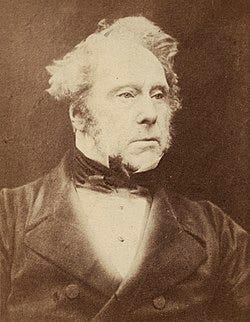
This wider context is important for understanding why the Expedition of the Thousand was successful. In the crude sense of publicly launching the expedition, Lord Palmerston did not openly support Garibaldi, but his role was still very important. In 1860, Britain's leaders were generally in favour of Italy becoming one country. Historians of British diplomacy say that London gave moral and diplomatic support to the formation of the new Italian state, even though there was a lot of opposition from other countries. Ministers in Parliament made it clear that Britain would not take part in actions to stop Garibaldi by force. That refusal was very important. It took away the kind of great-power intervention that could have killed the expedition at birth, and it made the diplomatic climate such that Garibaldi could keep moving south without being crushed by a European coalition.8
Lord Palmerston
Palmerston was also important because his policies let things grow around Garibaldi, ensuring that the British government - already interested in the Italian cause - would be at least tacitly favourable to the latter’s action. Elena Bacchin's research on Garibaldi's British Legion shows that people in Britain were actively signing up to fight for Garibaldi in Southern Italy in the summer of 1860, and British fundraising and practical help were also going in the same direction.9 Sympathetic Englishmen in Liverpool and London raised funds and even smuggled weapons to aid his redshirt volunteers. The “Garibaldi Special Fund” in Britain and pro-Italian societies in places like Malta channeled external resources to the cause.
British public opinion was so pro-Garibaldi that when reports emerged of brutal repression in post-unification Naples (which we’ll discuss in detail in a later section), British MPs were largely dismissive.
None of the above proves concusively that English Freemasonry was the only actor that contributed to Risorgimento, but it does show that Garibaldi's campaign was helped by a British environment where liberal sympathy, public activism, and networks that crossed over with the masonic milieu. Garibaldi’s Expedition would have been less connected without the lodges, and his gamble might not have lasted long enough to effect a regime change in Southern Italy without Palmerston.
What was Italy “supposed” to look like?
Initially, Risorgimento was understood - at least by Lombard and Piedmontese elites and the middle class - as aimed at the creation of a Kingdom of Italy limited to the North-West and Tuscany. However, despite the hopes of confederalists and supporters of a more “decentralized” configuration for Italy, the final result was a single state that comprised both the Italian peninsula and the Cisalpine region.
Was it inevitable? Let’s explore the major events that led to it.
The Plombières Agreement (and its violation)
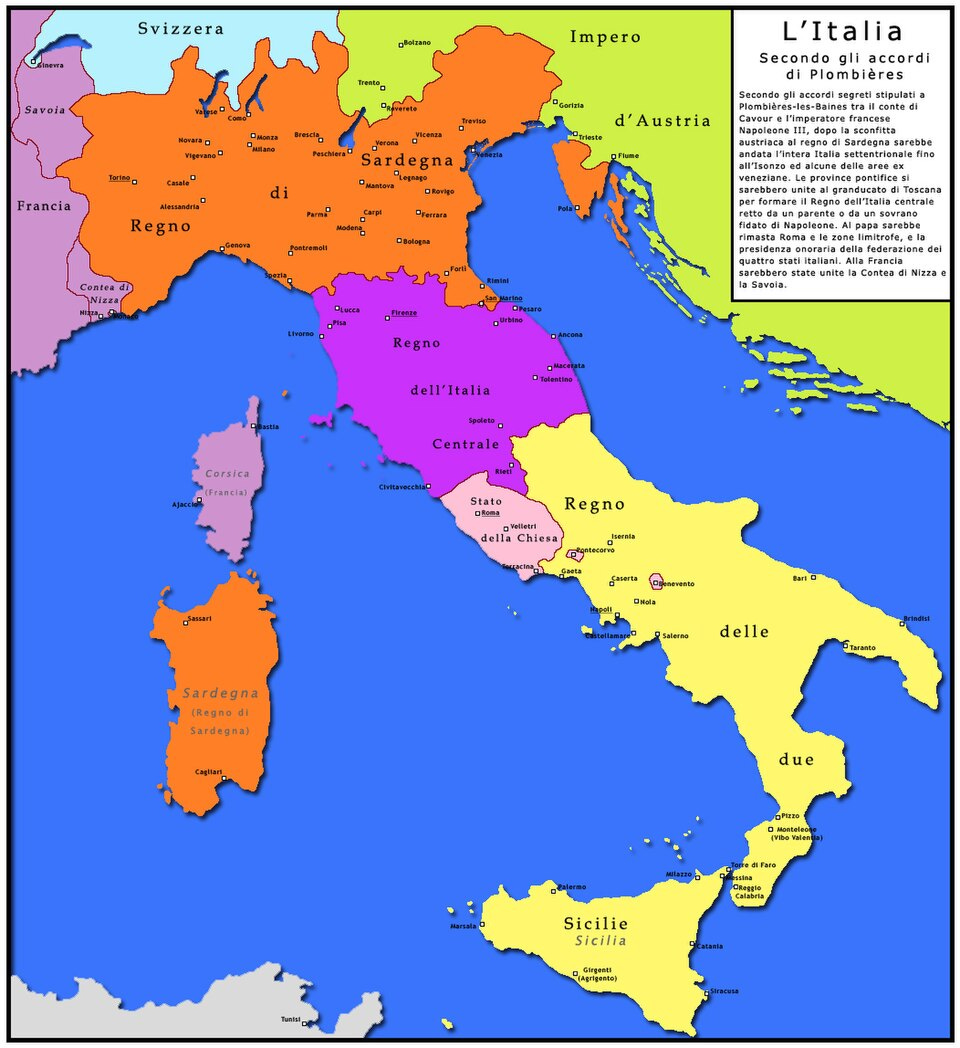
The secret Plombières Agreement between France and Sardinia-Piedmont, signed on the eve of the Second War of Independence would have ensured French support against Austria for the creation of a unified Northern Italian state under Piedmontese leadership.
Italy according to the Plombières Agreement.
The logic of the Agreement was that Napoleon III did not intend to support a large, independent Italian power that could escape French influence and expand into the Italian peninsula, but rather a reordering of the Cisalpine region under Piedmontese leadership.
The agreement would not actualize, however, because of Piedmontese ambition and speed: Cavour moved beyond the limited aim of liberating Lombardy and pushed for the annexation of Central Italy, especially Tuscany and Emilia-Romagna, where the collapsing governments were replaced by pro-Savoyard regimes. To France, this looked like an attempt to use the war to decisively expand Piedmontese power.
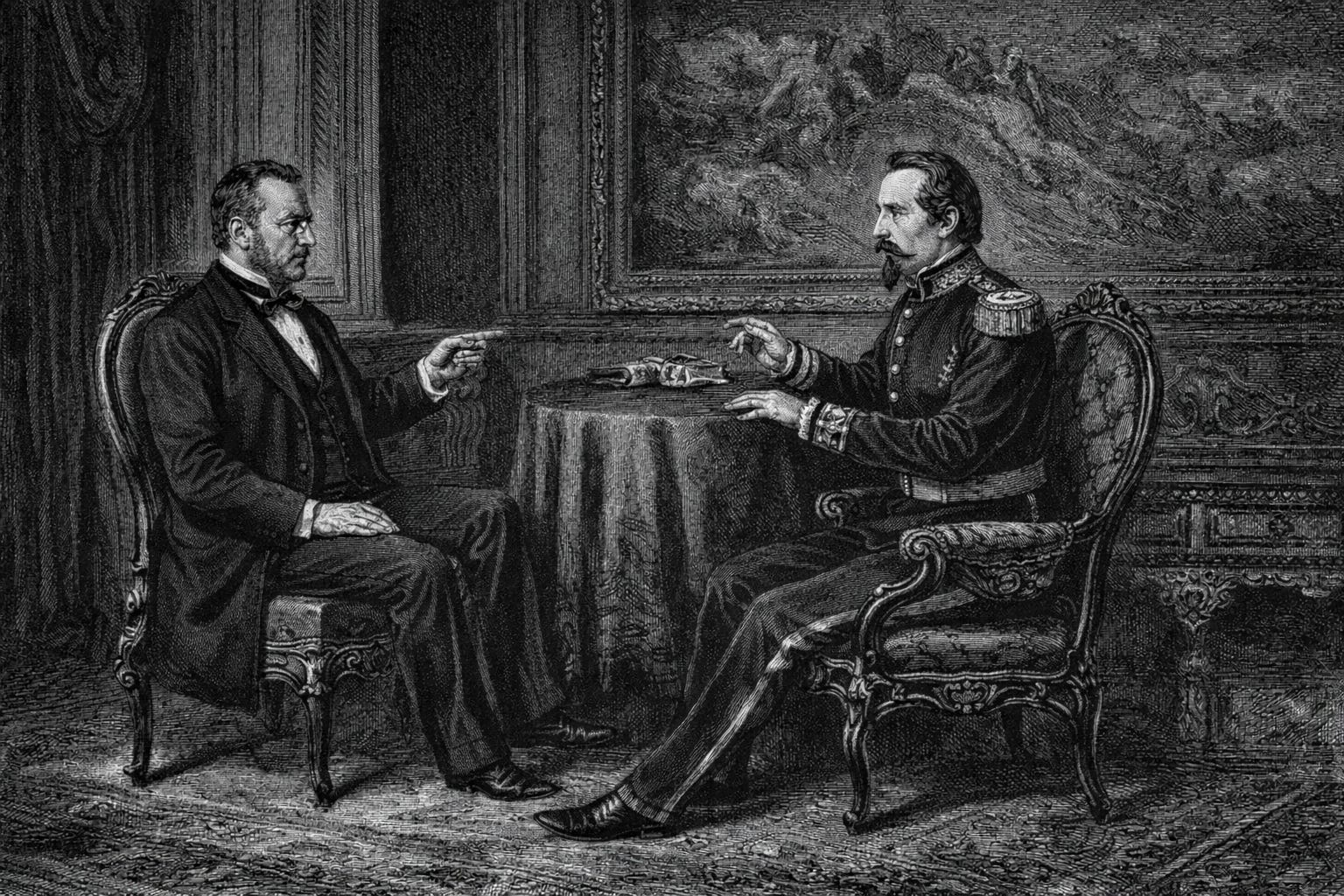
Cavour and Napoleon III
This helps explain Napoleon III’s sudden armistice with Austria: fearing an overmighty Piedmont, he made peace on terms designed to limit its gains. Lombardy would pass to Piedmont, but the deposed central Italian rulers were to be restored. Piedmont answered with plebiscites, using popular consultations (more or less coercive) to legitimize the annexations and bypass the French restoration plan.
Nice and Savoy were then ceded to France to secure Napoleon III’s acceptance of the new settlement. The outcome was not a single coherent plan, but a chain of moves and countermoves between France and Sardinia-Piedmont.
From a Northern Italy Kingdom to an unplanned(?) peninsula-wide state
A mere 45 days after the annexation of Tuscany, Emilia and Romagna, Garibaldi would launch the Expedition of the Thousand (Spedizione dei Mille) - aimed at the conquest and “liberation” of Southern Italy from the Bourbon monarchy - without formal authorization from the Savoyard crown, though likely not without at least tacit support from parts of the Sardinian establishment.
It must be reiterated that the Expedition of the Thousand was not a carefully integrated state-building plan, and it created a sudden fait accompli that the House of Savoy had to contend with. Once Garibaldi handed the South to the Savoyard crown, the regime effectively found itself governing a much larger and more heterogeneous space than it was prepared for.
At that point, a coherent solution would have required redesigning the state’s architecture almost from scratch—constitutional settlement, administrative model, fiscal system, civil-military governance, and a viable equilibrium between radically different socio-economic zones. Instead, for reasons of convenience and political bandwidth, the choice was to “leave things as they were” as much as possible, extending Piedmontese institutions outward rather than building a new composite structure.
Rebuilding the system on federal or confederal lines would have demanded time, competence, and political risk that the ruling elite did not want to bear. In principle, alternative models existed - a German-style confederation, an American-style federation, even a dualist/compromise model not unlike the later Austro-Hungarian arrangement - but those were not the paths taken. The resulting centralism can be read as a low-friction method of control: once the state had been extended by annexation, the cheapest way to maintain order was to standardize administration, policing, taxation, and conscription.
The “nationalist completion” rhetoric would be employed both for the legitimization of the annexation of the South (and for the subsequent repression of its uprisings), as well as for the war of conquest launched in 1866 to acquire Venetia from Austria. In reality, the motivation for the “Third War of Independence” was likely economic: annexing the Northeast meant acquiring a productive region whose resources could help offset the fiscal, demographic and developmental weight of the recently annexed South.
Again we have to ask: was the conquest of the South inevitable, or necessary to the proclamation of the Kingdom of Italy?
While it’s true that such proclamation happened after the annexation of the South, we argue that it was not a precondition for it, because the new state was declared in 1861 despite the continued exclusion of key territories that were widely considered part of the Italian question, most notably Rome. Since the kingdom was proclaimed while these regions remained outside its control, territorial completeness was clearly not required for the act of proclamation itself.
Regarding the inevitability of the annexation, one may hypothesize that - even without the Expedition of the Thousand - the South would likely have been brought under Northern hegemony in some form by the end of the 19th century - if not through outright annexation, then perhaps through a more openly colonial or otherwise subordinate arrangement. The South was not regarded by the Savoy monarchy itself (or indeed by public opinion in both Northern Italy and even the rest of Europe) as organically “Italian”, but it remained a territory whose strategic control was necessary to any power that claimed Central Italy.
Few actors had both the interest and the practical means to impose that control more than the House of Savoy, especially in alignment with British interests and wider Masonic-political networks. From this perspective, the Risorgimento can be seen as an anti-national project: it invoked national language, and relied on Gallo-Italic populations as manpower and as a source of popular legitimacy, but it ultimately served a hegemonic and expansionary logic rather than a genuinely national one.
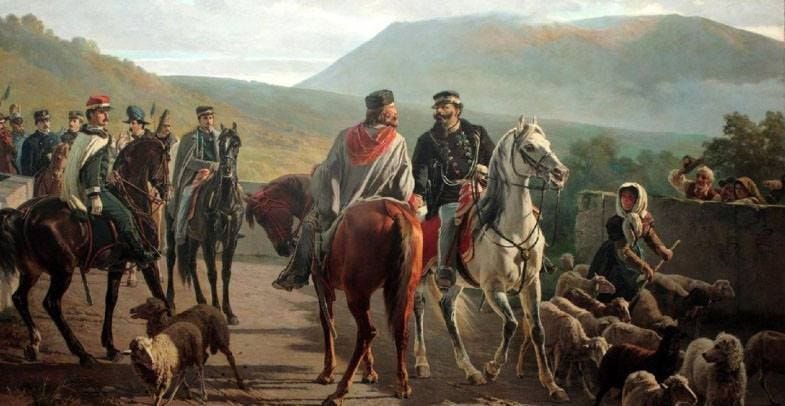
The Teano meeting in 1860, where the armies of Savoy and Garibaldi crossed paths. Garibaldi handed the conquered Mezzogiorno over to King Vittorio Emanuele II, whose official objective was to defend the Papal States from Garibaldi’s army. In fact, Napoleon III had threatened to intervene militarily if this were to happen.
This meeting enabled Victor Emmanuel II to extend his dominions to the Kingdom of the Two Sicilies and the regions of the Papal States that he had occupied.
Reactions to Unification: Resistance and Passivity
The consequences of the incorporation of heterogeneous regions and peoples into a single centralized state lacking actual popular support were not as seamless as pro-unification narratives describe them.
The rosy image of Italians from Sicily to the Alps yearning to join as one nation is largely a retrospective construction. The historical record suggests a practical abscence of popular participation to Risorgimento, and a weak identification with the new state - in some regions even outright hostility and active opposition to it. As we described above, Risorgimento was driven above all by elites (who in turn benefited to varying degrees, with some even losing their status in the new order), while much of the population remained attached to local loyalties, older regimes, and social expectations that had little to do with national ideology.
The gap between the rhetoric of “national liberation” and the lived experience of unification is nowhere clearer than in the South and in Venetia.
For most ordinary people, the new kingdom arrived as a change of rulers, laws, taxes, and military obligations. The idea of “Italy” had circulated among educated minorities for decades, but it was far weaker among peasants and provincial communities, who were more likely to identify with their own region and former rulers than with an abstract nation. This helps explain why the new state so quickly encountered not only apathy, but resistance.
The Southern crisis after 1861 - what the new Italian authorities called “Brigandade” - took the form of a broad and violent insurgency as bands of irregular fighters – labeled “brigands” by the Italian authorities – waged a guerrilla war against the Piedmontese occupation for years. At its peak, this conflict resembled a full-scale civil war in the south. Entire villages rose in rebellion proclaiming loyalty to the deposed Bourbon king or simply protesting the harsh new taxes and conscription imposed by Turin. In Basilicata, Campania, Apulia, Calabria, and Abruzzo, local resistance leaders (some former Bourbon soldiers, others simply charismatic outlaws) commanded hundreds of fighters. They enjoyed considerable support or acquiescence from peasants, clergy, and small-town notables who felt little allegiance to distant Piedmont.
Recent quantitative research by Matteo Ruzzante and Cristoforo Pizzimenti argues that this conflict is better understood as the political afterlife of monarchical legitimacy in the former Kingdom of the Two Sicilies. In their account, rebellion drew strength not only from material grievances, but also from a collective memory of loyalty to the Bourbons, intensified by disappointment with the new regime and resistance to northern laws and conscription.10 This study shifts the Southern upheaval away from the reassuring category of mere banditry and toward that of an actual civil war, which can be understood as an ethnic “transplant rejection”, reflecting the impossibility of “national integration” of heterogeneous ethnic groups under a centralized regime.
The Italian government suppressed news of the Southern rebellion as much as possible, not wanting to tarnish the narrative of happy unification. Still, reports leaked out and even foreign observers took note.
In the debate of the 8th of May, 1863, in the English House of Commons, various speakers agreed the so-called “Brigandage” - was really a civil war11:
“The Brigandage,” said Mr. Cavendish Bentinck, “is a civil war, a spontaneous popular movement against foreign occupation, similar to that carried on in the kingdom of the Two Sicilies from 1799 to 1812, when the great Nelson, Sir John Stuart and other English commanders were not ashamed to enter into relations with the brigands of that day, and their chief Cardinal Ruffo, for the purpose of expelling the French invaders.”
In the same debate, Benjamin Disraeli demanded:
“I want to know on what ground we are to discuss the state of Poland, if we are not permitted to discuss the state of Calabria and the Two Sicilies. True, in one country the insurgents are called brigands, and in the other patriots; but, with that exception, I have not learned from this discussion that there is any marked difference between them.”
A significant part of the Southern population did not experience unification as national redemption, but as the imposition of an alien ruling class. The Piedmontese-led state, rather than negotiating durable legitimacy, responded to ethnic instances with militarization. Special legislation, above all the Pica Law of 1863, effectively turned large parts of the South into an occupied zone, making repression systematic.
The methods used to crush the revolt were extreme: public executions, the exposure of corpses, village burnings, mass killings, and deportations. These were not isolated excesses, but recurrent techniques of pacification. The new state did not consider resistance as a political symptom to be understood and compromised with, but instead labeled it as “criminal activity” to be eradicated.
The South wasn’t the only area which displayed apathy or hostility when faced with the new Italian state. In Venetia and in parts of the Papal States, many rural Catholics opposed the liberal government. In the Alpine areas like Trentino (then under Austria, but where Garibaldi led incursions in 1866), the local populace did not rush to join Italy. Gilberto Oneto recounts that even with patriotic rhetoric blaring,
“when [Garibaldi’s officers] resorted to forced enlistment, the people [of Trentino] did everything to avoid participating. Recruiters pushed into the most remote villages with alluring proclamations, yet none of the local inhabitants could be convinced…”.12
Italian police reports from 1866 confirm “no one from our border inhabitants would let themselves be persuaded” to join Garibaldi’s volunteers - composed as much by adventurers from abroad (even some from Poland, Hungary, and other countries) as by native “Italians”.
After the 1866 annexation, Venetia experienced its share of repression, as we recounted in a dedicated article:
We have already covered the topic of the annexation of Venetia to the Kingdom of Italy in 1866 in a previous article, and in this article we want to expand on it, going more in-depth on specific cases and detailing how life went on for Venetians under the new regime.
The passivity and resistance encountered by the new Italian state was evidence that that it had not been unified according to a shared national consciousness, but rather on the basis of a national-liberal project based on geopolitical hegemony and abstract ideas of a non-existent “Italian” nation. The new state had to manufacture political loyalty after the fact through administration, schooling, conscription, and repression - a mission that it has not even achieved today.
The Consequences of Risorgimento
Centralism: Italy’s original sin
If Italian unification did not arise from a fully formed and broadly shared national identity, what exactly did it produce?
Above all, it created a state. The new Kingdom of Italy did not emerge by accommodating the peninsula’s historical plurality of peoples, laws and traditions in an organic way, but extended a single political model far beyond the territory in which it had originally taken shape - pre-existing legal traditions were displaced, as Piedmontese legal and bureaucratic frameworks were extended to the annexed territories through a hierarchical chain of province, district, and municipality overseen by centrally appointed prefects.
This centralizing choice was not inevitable. In the years around unification, figures such as Luigi Carlo Farini and Marco Minghetti had advanced more decentralising proposals, imagining regional bodies endowed with broad liberties within a unified state. But these possibilities were abandoned, and the Ricasoli government effectively settled the question in favour of centralism.
The new Italian state was held together by a unity of law and administration, but not much else: a common language had to be taught (or imposed), a common civic identity had to be inculcated, common symbols had to be imposed from above. Massimo d’Azeglio, a Piedmontese statesman, famously quipped after 1861: “We have made Italy; now we must make Italians”.
Regional languages, local traditions and histories, and older loyalties were not simply left to coexist with the new state, but would be progressively subordinated to it and repressed, or appropriated when proven impossible to cancel.
As a result, Italian identity from the late nineteenth century onwards must be understood as inextricably tied to the Italian state, and inherently anti-national because its affirmation was predicated on the negation (and appropriation) of pre-existing regional histories and cultures. The meaning of “Italian” that had existed since the Middle Ages - both intended as the Gallo-Italic ethnic identity, and the imperial, universal, pluralistic idea of Italy - was effectively substituted for an artificial civic identity.
Retrospectively attributing a single, continuous Italian identity to the many societies that inhabited the peninsula across different centuries has been a habit for Italian historiography ever since unification.
Italian centralism didn’t only produce a loss on an cultural or folkloristic level, but had consequences on the institutions of the new state: by imposing a single centralist model across regions marked by strong ethnocultural propensities, the new kingdom generated tensions and dysfunctions that persist to the present. So much so that much of Italy’s later fragility, incompetence and executive paralysis can be directly attributed to the decision to adopt a centralized governance model.
Only one model of unification - the Savoyard one - prevailed, and only later would Italian historiography retroactively harmonize the historical narrative of how the Italian state came into being. This conventional historiographical tendency to place Mazzini, Cavour, and other divergent figures side by side as complementary “founding fathers” is misleading, because they represented rival and often irreconcilable projects.
Following the proclamation of the Italian Republic in 1946, the official narrative was rewritten to play down the roles of the monarchists Victor Emmanuel II and Cavour, and play up those of Mazzini and Garibaldi. These republicans were more aligned with the country’s new domestic political order, which comprised the pro-American Christian Democrats and the pro-Soviet Communist Party. However, nothing changed in terms of the vision of Italian identity itself.
Ethnic competition within the united Italian state and the “Southernization” of public service
As we described earlier in the article, The North-Western (Gallo-Italic) population’s desire for self-determination was mobilized and exploited above all by the Savoy monarchy and its French (later British) alliance after playing on the former’s expectation of an independent state of their own - “Italy”, but limited to the North-West+Tuscany. After unification, the same populations that supported Sardinia-Piedmont bid for unification found themselves absorbed into a centralized state that no longer corresponded to the expectations under which they had been drawn into the “national” project.
Again, we should not make the mistake to think that, just because it led the unification process, Sardinia-Piedmont was somehow advantaged by it. While the public administration of the new state was initially comprised of ethnically Piedmontese and Northern officials, in just a few years the balance would shift in the opposite direction, as a new wave of Southern Italian bureaucrats occupied almost all positions - from local to high politics.
In Bruno Pederoda’s account of the years following unification (which we have discussed in detail in another article), the administration of the newly unified Kingdom of Italy did not become “Southernized” immediately.13 In its first phase, the state remained largely dominated by Piedmontese and other Northern personnel. As the new regime extended the administrative model of the Kingdom of Sardinia across the peninsula, it relied on these officials, trained in a political culture in which public service still carried considerable prestige. Many of these men were sent South to (hopefully) implant the institutions, habits, and authority of the new centralized state.
Over time, however, this balance changed, primarily due to a series of changes in incentives.
Service in the South was often harsh, insecure, and socially unrewarding, especially after the instability of the post-annexation years. At the same time, the economic development of the North made commerce, industry, and the professions increasingly more attractive to young Northerners than a bureaucratic career. As Northern interest in state service declined, candidates from the South entered the public administration in growing numbers, since government employment offered status, stability, and access to advancement.
The transfer of the capital first from Turin to Florence and then to Rome accelerated this transformation. As the political center moved away from the Northwest, the old Piedmontese bureaucratic core weakened. Rome was geographically and socially less integrated with Northern networks, and many Northern officials proved reluctant to relocate permanently or build careers there. This created space for Southern personnel to occupy an ever larger share of ministerial and administrative posts, gradually altering the composition of the state apparatus at its core.
A similar shift happened in the military: in 1876, Luigi Mezzacapo, freshly installed as Depretis’s war minister, sent thirteen generals into retirement - officially for age, though ten happened to be Piedmontese. In their place came Mezzacapo’s brother Carlo as a corps commander, General Nunziante to chair the commission for the line army, and Colonel Primerano as ministry secretary: all Southerners, seen by contemporaries as the face of a renewed “Bourbon” administration.14
The resentment that later accumulated in Northern Italy was not accidental, but one of the consequences of a people being mobilized for one national project and being incorporated in a state that did not fulfill their desire for ethnic self-determination, and instead doubled down on their disenfranchisement.
The various unification currents that had been more or less exploited against the old states did not dissolve into a harmonious national identity once they were enclosed within a unitary state, but would continuously emerge as competition among regional elites for influence over administration, resources, and political direction. What had been presented as national synthesis became, in practice, a struggle over who would control the state created in the name of “the Nation”.
A similar interpretation - for the British context - has been presented by Charles Small in his articles:
“A history of broken promises” may be the best way to describe Italian Risorgimento: it promised liberation, but delivered subordination to a centralized monarchy; it promised convergence, but generated new internal rivalries; it promised national fulfillment, but left behind strong regional memories of dispossession.
Ruzzante M., Pizzimenti C., “Brigandage and the political legacy of monarchical legitimacy in Southern Italy” in Journal of Economic Behavior & Organization.
This is such a well-thought, expansive, and historically relevant piece that asks the enduring question of the ages: why? Why this happened, who benefitted, who promoted it, and what the actual state of play was at the time amongst the populace.






This is such a well-thought, expansive, and historically relevant piece that asks the enduring question of the ages: why? Why this happened, who benefitted, who promoted it, and what the actual state of play was at the time amongst the populace.
Grazie!!